
______________________________
Videos at CriticalCommons.org
Video 1—Robots in Agriculture
______________________________
The Industrialization of Agriculture
Part 3: Getting Big
If I were to describe a U.S. farm at the end of the 20th century I would describe it as having about 80 acres of crops (notably corn and/or wheat), 50 hogs, 40 cows, and 20 laying hens.(N2) Much of the inputs used on the farm the farmer supplies herself. The plow used to turn the ground, the scythe used to cut the rye, and the lumber used to make the barn, these would probably have been purchased from someone else, but the farmer will be self-sufficient in other regards. The fertilizer for the land she will obtain from the manure of her livestock and crop rotations involving legumes. She grows the corn that is fed to the hogs, and the wheat seed came from last year’s harvest. The hay comes from her own meadows, and the chickens hatched from eggs right on her farm.
Visit the farm and parts would have the rural romance we envision, like livestock with plenty of room to roam and dry areas to rest in the warm sun, but much would seem somewhat disturbing. Hogs and chickens would indeed be outside with the cattle, but this is partly because the farmer wants hogs and chickens eat the undigested corn present in the cattle manure. Sometimes the chickens and hogs would have to scavenge for their own food, especially in winter, and spring might find some animals skinny and sickly from a lean winter in confinement.(N2,O1)
Go to a farm today and you will find the farmer to be highly specialized, receiving most of her inputs from other industries. If she raises crops, she does so on fa more than 80 acres. If she raises livestock she probably only raises hogs, chickens, or cattle, and lots of them. She buys her fertilizer from a company. She buys her pesticides from a company. On some hog farms, the only thing the farmer even owns is the land and the building—a company even owns the hogs and provides all the feed! Some people would have trouble even calling these farms. Many wheat farmers no longer own combines, but pay other people to harvest it for them. Some cattlemen still rely on bulls they own for natural breeding, but many purchase semen from a company and artificially inseminate their cows.
When we say that agriculture has been industrialized, we mean that farms have become bigger, more specialized, and place greater reliance on inputs produced in big factories by corporations using advanced science. Farmers are no longer "jacks of all trades, master of none," but are masters at producing only a few goods on a large scale. They are remarkable experts at a few very specific skills, like caring for hogs or managing fields of barley, but they also depends on experts of other trades for their fertilizers, pesticides, machinery, and the like.
Most of these farms when I started farming had livestock on them. People were raising hogs, people were raising cattle, and even some people when I was a kid had chickens. These big corporations industrialized livestock production. That took the livestock off of the family farm and put them in these big factories.
—George Naylor, Corn-belt farmer, interviewed in the documentary Fresh 2012.
In this lecture we want to look at two sources of efficiency gains, economies-of-scale and specialization, and their influence on modern agriculture.
The source of efficiency: economies of scale
Economies-of-scale exists whenever a firm can lower its average production cost by becoming bigger. This is the reason so many businesses and industries are huge. The next time you go to a Waffle House, one of the few restaurants where you can watch the cook, observe him for a while. This one person doesn’t cook one type of food for everyone, but must manage perhaps a dozen or more different food requests. In particular, observe the amount of time it takes him to transition from one type of food to the next. For instance, placing the spatula down (which was used to stir scrambled eggs) and walking to the waffle iron, then walking to the freezer to retrieve a package of frozen hash browns, and then walking back to the eggs, and so on.
Much of his time is spent just thinking about which food he will tend to next. If instead of cooking a dozen different foods he could cook just waffles, he would become much more efficient at waffle-making. The same could be said if he only cooked eggs, or only hash browns. Because there is less wasted time moving from one food to the next, the amount of time it would take him to produce one waffle would fall considerably.
Compare this to a farmer who produces ten different crops in addition to raising chickens for eggs, chickens for meat, beef, pork, and milk. So much of her time is spent moving from one endeavor to another that she is relatively inefficient at producing everything. Conversely, if she decided to produce only milk she could focus all her energy on milk production, and every second that had been used in switching from one farm product to another could now be spent milking and caring for the cows. She no longer produces corn or eggs, but few can produce milk more efficiently.
There are other reasons why economies-of-scale exist. One has to do with efficient use of fixed costs. Suppose a farmer takes a loan to pay for a barn to store his equipment, and the loan payment is the same no matter how much grain he harvests. If he is able to produce more grain without needing a larger barn, the cost of that barn on a per bushel basis falls (because the monthly payment is the same but is divided by more bushels).
Large firms can purchase inputs in-bulk, allowing them to negotiate lower prices. It is easier for them to lobby politicians and to experiment with new methods. To illustrate the various benefits of size, consider the following excerpt from author trying to sell the public on allowing health care firms to become larger.
Big chains thrive because they provide goods and services of greater variety, better quality, and lower cost than would otherwise be available. Size is the key. It gives them buying power, lets them centralize common functions, and allows them to adopt and diffuse innovations faster than they could if they were a bunch of small, independent operations. Such advantages have made Walmart the most successful retailer on earth. Pizza Hut alone runs one in eight pizza restaurants in the country. The Cheesecake Factory’s major competitor, Darden, owns Olive Garden, LongHorn Steakhouse, Red Lobster, and the Capital Grille; it has more than two thousand restaurants across the country and employs more than a hundred and eighty thousand people. We can bristle at the idea of chains and mass production, with their homogeneity, predictability, and constant genuflection to the value-for-money god. Then you spend a bad night in a “quaint” “one of a kind” bed-and-breakfast that turns out to have a manic, halitoxic innkeeper who can’t keep the hot water running, and it’s right back to the Hyatt.
—Gawande, Atul. August 13 & 20, 2012. "Big Med." The New Yorker. Pages 53-63.
Evidence of economies-of-scale are all around you. Most products today are produced in big factories and in massive amounts, and our wealth allows us to buy more and more of these profits, which must mean that the real prices of these products are falling. The only way a business can survive in an era of falling prices is if their costs are falling also. The same goes for farms. On average the price of farm products is lower than it was a century ago, and the only farms able to stay profitable are the very efficient farms with very low costs. Since it is generally the large farms that survive, it seems evident that larger farms are more efficient.
We don't have to rely on that logic though. When economist investigate the relationship between the size of a farm and its costs, the tend to find the following.
The more cattle dairy farmers tend to milk, the lower their cost of producing milk.
Figure 1—Relationshiop between herd size of farm and its production cost (dollars per cwt of milk produced)(M9)
(Figure taken from screenshot of (M10))

The more hogs a farmer produces, the lower her production cost of live hogs.
Figure 2—Relationship between farm size (total cwt of hog weight produced on farm) and its cost of production (dollars per cwt of gain produced)(K1)
(Figure taken from screenshot of (M10))

Figure taken from screenshot of (M10).
Economies-of-scale exist in many other settings, not just livestock and not just agriculture. Large corn farms produce at a 38% lower cost (per bushel) than small corn farms,(L2) and a large brewery has half the costs (per ounce) of a small one.(T1) This is not meant to suggest that economies-of-scale always exist. A business can become so large that when it tries to produce more its production costs rise. Back in the 1930’s J.P. Morgan owned a 95,000 acre farm,(T2) but that evidently turned out to be too large, as I don’t know if there are any farms that big today.
The source of efficiency: specialization
With economies-of-scale always comes specialization. By producing more of a single good one can really hone their skills on that one good. You now have more incentive to invent more efficient production practices. The farmer who produces 20 different things has little incentive to invent new egg production methods, because that was only 1/20 of her job. But if she specializes only in eggs that invention will improve her entire business.
It is hard to specialize in something unless you produce a lot of it, and it’s hard to produce a lot of something without specializing in it, and this is why specialization and economies-of-scale are twins of efficiency. For this reason, from this point forward when I say specialization I’m implying there are economies-of-scale also, and vice-versa.
The benefits of specialization is nothing new. It is as old as the written word, as this the following narratives from the Greek philosophers Plato and Xenophon demonstrate.
And now let us see how our city will be able to supply this great demand: We may suppose that one man is a husbandman, another a builder, someone else a weaver — shall we add to them a shoemaker, or perhaps some other purveyor to our bodily wants?
Quite right.
The barest notion of a State must include four or five men.
Clearly.
And how will they proceed? Will each bring the result of his labors into a common stock?— the individual husbandman, for example, producing for four, and laboring four times as long and as much as he need in the provision of food with which he supplies others as well as himself; or will he have nothing to do with others and not be at the trouble of producing for them, but provide for himself alone a fourth of the food in a fourth of the time, and in the remaining three-fourths of his time be employed in making a house or a coat or a pair of shoes, having no partnership with others, but supplying himself all his own wants?
Adeimantus thought that he should aim at producing food only and not at producing everything.
Probably, I replied, that would be the better way; and when I hear you say this, I am myself reminded that we are not all alike; there are diversities of natures among us which are adapted to different occupations.
Very true.
And will you have a work better done when the workman has many occupations, or when he has only one?
When he has only one.
—Plato (424-348 B.C.) in The Republic. Book II: The Individual, The State, And Education. A conversation between Socrates and Glaucon, and perhaps some others.
Just as the various trades are most highly developed in large cities, in the same way food at the palace is prepared in a far superior manner. In small towns the same man makes couches, doors, plows and tables, and often he even builds houses, and still he is thankful if only he can find enough work to support himself. And it is impossible for a man of many trades to do all of them well. In large cities, however, because many make demands on each trade, one alone is enough to support a man, and often less than one: for instance one man makes shoes for men, another for women, there are places even where one man earns a living just by mending shoes, another by cutting them out, another just by sewing the uppers together, while there is another who performs none of these operations but assembles the parts, Of necessity, he who pursues a very specialised task will do it best.
—Xenophon (431-355 BC) in Cyroppaedia.
Getting big and producing more
Specialization can be seen in the following charts, where the percent of farms with a particular form of crop or livestock falls considerably over time. Yet agriculture is producing more of everything, which means the few farmers who specialize in any particular crop or livestock is producing on a large scale and at a low cost.
Figure 3—Number of farms growing corn(G2)

Figure 4—Percent of farms raising select crops(G2)
(Figure taken from screenshot of (M10))

Figure 5—Percent of farms raising select livestock(G2)
(Figure taken from screenshot of (M10))

Figure 6—Number of commodities produced per farm(D1)
(Figure taken from screenshot of (D1))
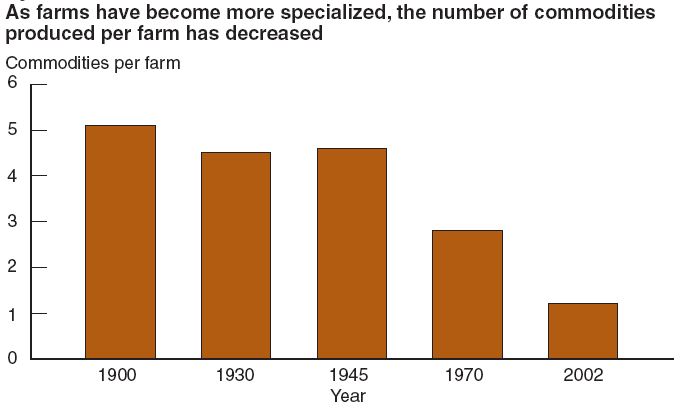
The drive towards larger farms necessarily drove smaller, less efficient farms out of business. This shouldn’t be thoughts of as, “demise of the family farm” or a corporate takeover of agriculture, as 98% of farms are family farms.(L2) Yet, even if it did, it’s not clear why that would be bad. Much of the American public works for corporations—are they less ethical than the family farmer for doing so? Of course not. Many retail stores used to be family-owned and family-run, does that make the large superstores who replaced them less moral?
In fact, the only way a nation can prosper is if it becomes more productive, allowing more food to be produced by fewer people, releasing some of the labor force to produce new things like cars and video games. If we are prospering as a nation, we should see fewer and fewer people producing more and more food, and that is what we see. The number of farms keeps falling, the average farm size keeps growing, and the food supply becomes more abundant.
If we just look at the average farm and its size it is evident that the average farm is much larger, and Figure 7 shows that this has led to a considerable reduction in the population whose occupation is farming.
Figure 7—Average farm size and number of farms over time(G2)

Figure 8—Number Of Farmers Over Time(N2)

Some industries are still going through radical change, like the surge in the number of hogs the average hog farm raises and the 70% decline in number of hog farms in the last twenty years.
Figure 9—Number hogs on average hog farm(N2)

Livestock farms in general are falling in number, specializing in few livestock species, and are nevertheless producing more meat, dairy, and egg products every year.
Figure 10—Livestock output over time(N2)
 U.S. farm output.png)
Figure 11—Number of livestock farms over time(N2)
specialization.png)
Industrial agriculture in three graphs
When you put everything together, and look at how farm size, number of farms, farm productivity, you get the undeniable impression that bigger, more specialized farms really are more productive. First you have the trend towards larger farms and fewer farms.
Figure 12—Change in number and size of farms(D1)
(Captured from screenshot of (D1)

Second for the years numbers are available, farms are becoming more productive as they become larger, allowing them to produce more food with the same number of inputs.
Figure 13—Change in farm productivity(D1)
(Captured from screenshot of (D1)

More productive farms does not guarantee more food, yet even when we look at how nutrient availability has changed over the last century there is an undeniable trend towards more nutrients. Whatever reservations one might have about the industrialization of agriculture, one cannot deny that it has made food more affordable and plentiful than ever before.
Figure 10—Change per capita nutrient availability in the U.S.(N3)

Technology and big farms
New technological developments in agriculture don't have to, but they usually do, favor big farms and encourage bigger and few farms. Consider some of the newest innovations, like the self-driving tractor, the robot fertilizer, and the robot milking machine. Would it be profitable for an eighty acre corn farm to buy a self-driving tractor? No, because the large expense would be spread over only a few acres, and the tractor cost on a per bushel base would be large, making its average production costs too high to operate. Likewise, the eighty acre corn farm is unlikely to buy a robot fertilizer, however cool it is. For the same reasons a dairy farmer with fifty cows to milk will not be able to affordable robot milkers, but a dairy with 5,000 will be able to use the machine for many cows, making the robot milker's cost on a per lb of milk basis low.
Video 1—Robots in agriculture
Land Grant Universities are sometimes criticized for studying and advocating technologies that favor large farmers, and in some ways I understand where this criticism is coming from. What the critics miss is that agricultural colleges are more concerned with provide safe, healthy, and affordable food than they are helping big farms—or small farms for that matter. Scientists want better, cheaper food, and if the technologies that achieve this tend to favor larger farms, so be it. Technology of any sort tends to favor larger businesses, and farming is no exception. If the goal of scientists were to prevent farmers from going out of business, they would be preventing innovation, not creating it.
In some cases government agencies and agricultural researchers have encouraged farmers to "get bigger." The Secretary of Agriculture durin gthe 1970s, Earl Butz, became famous for telling farmers they should "get big or get out."(K2,N3) This was not because he favored larger farmers per se, but because he thought larger farmers produced at a lower cost and would eventually be the only ones able to operate profitably.
Those initial farm bills [of the 1930s] were also structured to encourage farmers to practice factory farming. Indeed, in the 1940s and 1950s, lawmakers, the USDA, and other government departments and agencies actively tried to move marginal farmers onto other lines of work, not because agribusinesses kept lawmakers and bureaucrats on a leash, but because economic policymakers believed that big farms could provide food and fiber to an urban population more cheaply than small ones.
Ogle, Maureen. 2013. In Meat We Trust. Houghton Miffllin Harcourt: NY, NY. Page 236.
The return of small farms
Lately there has been a shift towards favoring smaller farms by some critics and customers. Part of this favoritism stems from some people's natural dislike of corporations, as they associate large farms with "corporate" farms. They believe that smaller farms are more ethical, being able to produce food more sustainably, with less environmental pollution while also contributing to the local economy. Remember the early twentieth century farm I described at the beginning of this lecture, with 80 acres of crops, 50 hogs, 40 cows, and 20 laying hens? That is the kind of small, diversified farm a unique group of consumers desires to produce their food, and they refer to them as "sustainable" farms. They might prefer the farm produce organically. What they protest is the industrialization of farming that occurred throughout the twentieth century.
Whether these "sustainable" farms really are sustainable or preferred is debatable, and is debated even by scientists within agricultural colleges. Because of this renewed interest in sustainable farming more scientists are researching less industrial styles of farming. Scientists, like consumers, have become more diversified in their preference for farm sizes and styles of production. Today, large farmers and the corporations supplying their inputs do not rely very much on agricultural colleges because they are educated, progressive, and technologically advanced. With the problem of producing lots of food solved, agricultural colleges have been slowly evolving away from helping the private sector and more towards addressing public issues like pollution and animal welfare, though we still work with both the public and private sector. Agricultural colleges fifty years ago would have been devoted solely towards improving productivity. Now they hire environmental economists, scientists who research pollution prevention, health specialists, and resource management experts. Fifty years ago agricultural economics departments like mine would have been called, the "Department of Agricultural Economics," but today they often contain the terms "natural resources, "consumer", and "applied."

