
Introduction
Humans have been raising hogs and eating pork for millennia and in almost every way you can imagine. Ancient Egyptians seem to have raised some of their hogs in confinement like we do today. In colonial America hogs were let loose on their own to find their own food and water, and the farmer would then search for them once or twice a year to harvest them. In this sense pork in colonial America was almost free. In 19th century New York there were “street hogs” that belonged to no one. They were allowed to wander throughout the city on their own, as they provided a service of eating trash others discarded. For instance, a butcher might throw the remains of his carcass behind the shop, knowing the hogs would reduce the carcass to mere bones. In Egypt today, the Christians receive trash from Cairo, and after they remove recyclable items like plastic and glass, they also remove discarded food which they feed to their pigs, thereby converting trash pork, and the pork manure to fertilizer.(N1,O1)
Today in the U.S. hogs are raised almost exclusively indoors, like the Oklahoma State University farm we are going to tour in this lecture. But they are not as modern as it might seem. As early as 1913 farmers were experimenting with raising hogs on concrete floors and inside buildings. The idea didn’t really take off until the last 50 years, and today, very few hogs will touch the earth.
If there is one thing you should know about hogs it is that they are difficult to handle. They are generally not mean, but they are clever and stubborn. If you want to herd them to a destination the best way is to lure them with food, as you can’t herd them like one would cattle or sheep. Fencing them in an area is difficult, because they will constantly scan the fence for weaknesses and, when one is found, they will escape. Even when the fence is strong they will scratch themselves by rubbing up against it, and this will eventually break the fence if not constantly maintained. One can use an electronic fence, which shocks them if they touch a wire or very heavy steel panels. A wooden fence is not strong enough and has too many holes.
Hogs are destructive. Turn them loose into a smooth, verdant field and they will immediately start digging holes, turning it into a World War I no-man’s land.
That is why you will lots of heavy steel in the building. You will also see them confined to rather close quarters and always on a solid floor. Anything remotely weak in this building will be quickly destroyed by the animals. Moreover, handling hogs always creates stress, so these buildings are designed so that the animals rarely need to be moved or handled directly by the workers.
We are going to start with a gestating sow, then go to where the babies are born. After that we will see the nursery where the babies are weaned, and finally the finishing floor, which grows the hog out until it is ready for slaughter.
In the last few decades the most popular—and most controversial—form of housing gestating (pregnant) sows is the gestation-crate, but due to its unpopularity with animal advocacy groups it is slowly being replaced with group-pens. We are going to see both, so that we can witness hog production as it exists today and how it might look tomorrow.
Gestation: the gestation-crate
Until it gives birth for the first time a female pig is referred to as a gilt. When the gilt is 30-32 weeks old it will be bred either with a live boar or, more likely, through artificial insemination. Once bred she is kept in a crate like the one below. These are called gestation-crates because they are for hogs who in gestation.
You will notice the crate has a hard floor and is so tight the sow cannot walk or turn around. Obviously, pigs would like to walk around, explore, lie on something comfortable, and socialize with other pigs, but there are good reasons for the gestation-crates.
Notice that the floor contains slats, so that her urine and manure can fall through and be carried away by a flushing system. If she lived in a pasture she would constantly be digging in mud-holes with others, where she will come into direct contact with the feces of other pigs. Keeping hogs separated from their manure keeps the hogs healthier. Compared to 70 years ago, when hogs would be kept on the ground or mulch, lungworms used to infect 50% of hogs but today only infect 11%. Most hogs in 1940 had kidney worms, but very few do today. Trichenella, a parasite that can infect humans if they eat undercooked pork, used to scare us into overcooking pork, whereas it is basically a non-issue today.(N1)
Why aren’t pigs placed in a larger pen with other sows? One reason is that sows can be cruel to one another. It is also hard to feed sows as a group, because the dominant sow will try and take all the other sows’ feed, making the dominant sow obese and the subordinate sows experience malnutrition. Sows cannot be given unlimited access to food, or they grow obese and unhealthy. Because they are given less than they would prefer to eat they will fight with each other for more food. With gestation-crates the sow can b assured of her precise nutritional needs.
In barren pigs the sows unsurprisingly become bored, and will fight with each other simply for something to do, which is another reason the are kept separate from one another.
Farmers want to keep their animals housed to keep them in good health, but these buildings are relatively expense, so they want to put as many sows in the barn as possible, something best accomplished using gestation-crates.
Hogs are very hard to move around. They are ornery, and sometimes seem to completely ignore human handlers. Moving a sow from one pen to another can be exhausting. By having each sow in an individual pen, if I want to artificially inseminate this sow or give her a shot, if she is in a gestation-crate I don’t have to fight with her to get her in a pen. She’s already in a pen, and I can do these things without stressing her out.
The gestation period for a hog is 3 months, 3 weeks, or 3 days, so when she is about 46-48 weeks old she will give birth for the first time, to about 12 piglets. She won’t give birth in a gestation-crate. Shortly before her expected birth she will be moved to a farrowing-crate, to which we will not turn our attention.
Gestation: group-pens
There are other ways of managing gestating sows; the group-pen is one of them. The basic structure of the building is the same, except that instead of housing each sow in an individual crate they are placed in a small group of about five sows. Each sow is given more square feet of space, so this reduces the number of sows one barn can hold and increases pork production costs. The extra room is necessary to prevent them from fighting and to minimize aggression while feeding them as a group. Other then allowing them a little more space to room, the group-pen differs little from gestation-crates. Sows are still in rather cramped quarters on a hard, slatted floor.
Birth and nursing
As you can see, the farrowing-crate is a lot like the gestation-crate. It’s a little bigger than the size of the hog itself, and there is no room for her to walk or turn around. But that is the precise point of a farrowing-crate. You see, sows are not necessarily good mothers. If the sow were placed in an open pen with her young she would lie down carelessly, crushing a number of her young. On some farms not using the farrowing-crate about one in four piglets might die, most of these from crushing.
There are ways of giving sows more room while also protecting the piglets, and we will see pictures of an alternative system in another lecture.
I was once told by a prominent hog producer who didn’t use farrowing-crates that it was easier for him to go without them, compared to most farmers. This is because he produced pork for buyers who wanted fattier pork than you find in the grocery store, and he remarked that it is common knowledge among producers like him that fattier hogs are better mothers. I don't think this has been scientifically confirmed (I've found that those who stand to gain from its validity believe it, and those who stand to lose do not), but if it is true it has interesting implications. This means that as the pork industry responded to consumers’ desire for lean meat (remember the slogan: pork, the other white meat?) they had to use leaner mothers, who are worse mothers. That made the farrowing-crate all the more important. As you can see, what we choose to eat can alter how a hog is raised. Farmers and consumers are in this together.
Notice the farrowing-crate is designed such that it’s not easy for the sow to lie down. She must do so gingerly—that’s the point, as it gives her piglets plenty of time to get out of the way of her huge body. Even with the farrowing-crates about 1 out of 10 piglets may die, and many of these from crushing, but some of the best farms can operate with a mortality rate of only 5% or so.
It’s also the case that some sows would choose to simply not nurse her piglets, if given the choice. With the farrowing-crate she has no choice but to allow all her piglets to nurse, so as you can imagine, that alone lowers the death rate of piglets. Sows sows even cannibalize their young, but I have no idea how frequently that occurs.
You see that some parts of the pen are equipped with a heat lamp. Piglets are sensitive to the temperature, and need to be given the freedom to find warmth when it they are cold and escape the warmth when they are hot, and the lamp accomplishes just that.
In the crate the babies have access to something they will not find in other stages of pork production: a soft mat for resting. The parts of the crate not covered by the mat have slatted floors so that the manure separated from the pigs, which helps keeps both the mother and piglets healthy.
As with the gestation-crate, the individual pen protects the sow from other sows and allows the farmer to feed her individually to make sure she is getting adequate nutrition.
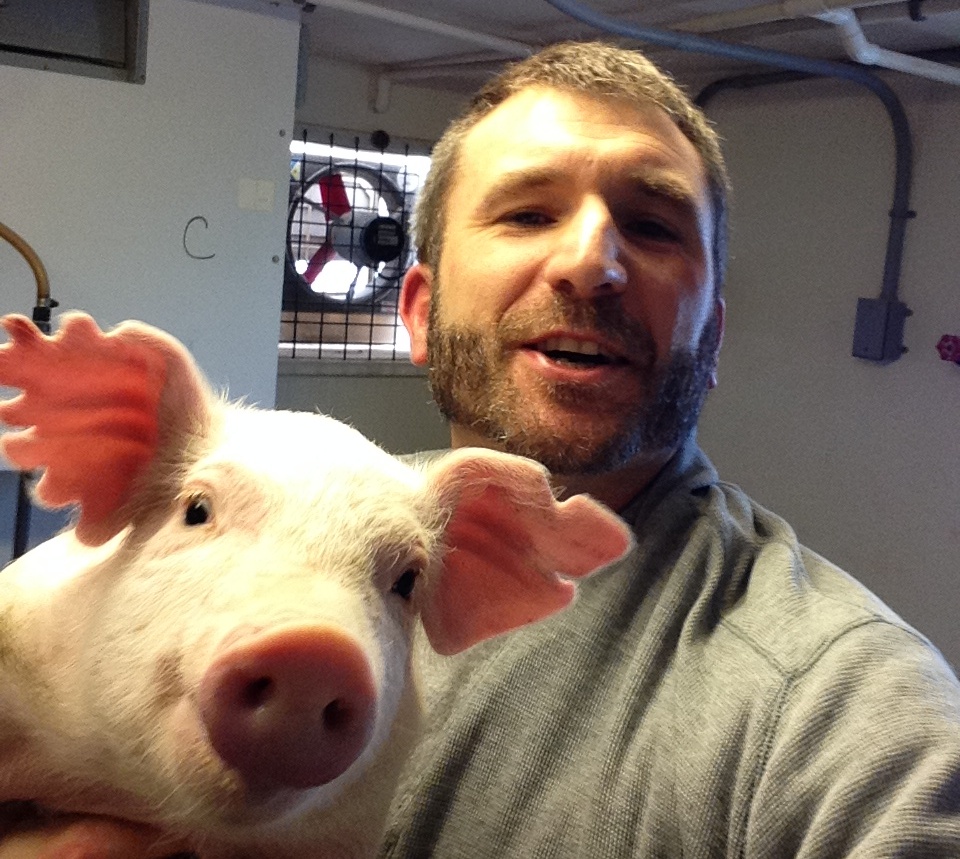
Shortly after birth (preferably within 7 days) all the piglets go through a few medical procedures. Their tails are docked to prevent other pigs from chewing on it (hogs do all kinds of things when they get bored!). The males are castrated, otherwise their meat will have an unpleasant taste. Some producers remove the needle teeth of piglets so that they don’t hurt their sibling’s or their mother’s teat, notches are made in their ear for identification—that’s basically the pig’s name. The location of each notch corresponds to a number, and the strong of numbers constitutes the pig's identification number. Alternatives to ear-notching are special tags or tattoos.
Figure —Dr. Norwood’s selfie with a pig (notice the notches in its ear, used as an identification)
Some of the females will remain in the barn to be used in breeding, and if so, they will have 4-7 litters until their productivity starts to fall, after which they are harvested for meat at around 3-5 years of age. Their meat will not be used for pork chops, but more processed meat like sausage.
For the barrows (young male pigs) and gilts, they will be weaned after about 3 weeks and placed in a nursery, and that’s where piglets are the cutest, so let’s go see them now.
The nursery
The piglets are now three weeks old, and growing incredibly fast. The nursery stage is one of the most important times in a piglet’s life. They are recently weaned and a little stressed out, and are at an age where their immune system is vulnerable. That why this is the most controlled and cleanest room on the farm. Notice that, like the gestation- and farrowing-crate, the slatted floors keep them separated from their manure. They are allowed to eat as much as they want and are given a diet precisely matched to their age.
Notice all the equipment used to control the temperature in the barn. There is gas heater for when it is cold outside and fans and cool cells for when it is hot. Throughout the barn, from the gestation-crates to the nursery, hogs are kept at a near constant temperature because that helps them to grow and reproduce fast, and also makes the pigs happier.
Once the stress of the weaning has tapered off, which will be about six weeks, they will be taken to the finishing floor, which is like the nursery, except bigger .
Nurseries often use an “all-in, all-out” system to prevent the spread of disease. All of these young pigs will be removed and sent to the finishing stage, until the nursery is completely empty. Once empty, it will be thoroughly cleaned and sanitized, after which a brand new group of piglets is brought in a roughly the same time. Being able to sanitize the room between groups prevents pigs leaving the nursery from passing on sickness to those entering the nursery.
The finishing floor
This is the last stage before slaughter. Like all the rooms discussed thus far, the hogs are on slatted floors to help keep them clean. Like the nursery, they are given all the food they wish to eat, a diet scientifically designed to provide their every need. Remember how the sows were given less than they would like to eat, and that was why it was helpful to separate them? Here, there is unlimited food, so you don’t need to worry about pigs fighting each other over food.
But of course, the pen is rather boring for them, and that’s why it was so important for their tails to be clipped. With nothing better to do, they’ll bite on each other’s tails.
Once they’ve reached the weight of 275 lbs it’s time to slaughter them for meat. They will be about 4-7 months old. That one 275 lb hog will provide 145 lbs of retail meat—enough to feed almost 3 people for a whole year.
The confinement system: a summary
You have just been given a tour of a small hog farm the university uses for research, but one that raises pigs in nearly identical settings as the conventional U.S. hog farm. It is called a “confinement” system for obvious reasons. All pigs remain indoors throughout their lives in cramped and barren quarters. The obvious drawback is that it denies the pigs many of the behavior needs they wish to perform, like exploring, digging, and carving comfortable sleeping quarters.
The advantages are that the system keeps hogs cleaner and freer of disease than they would in an outdoor system where they wallow in the mud in groups and encounter the feces of wild animals. The pens are designed to minimize aggression between hogs and to deliver each animal its precise nutrient needs.
It should also be noted that there is no such thing as a single confinement system. At the gestation crate we showed you two different types of pens. One was the gestation-crate and the other was the group-pen. Proponents of the group-pen argue that it allows them to turn around and gives them more room, while its opponents rebut that it increases injury and costs.
If you ask animal scientists their opinions about gestation-crates and group-pens in terms of animal welfare, you may hear a variety of responses. Some, like Dr. Janeen Salak-Johnson of the University of Illinois, are vocal opponents of the group-pen system, or at least, oppose farmers being forced to use group-pens instead of gestation-crates by legislation or voter initiatives. The prestigious Journal of Animal Science published two articles, one using mathematical modeling and the other using expert opinion, showing that group-pens were more humane than gestation-crates. These articles do not seem to have convinced all animal scientists. Most, when I ask them, will not deem one superior to the other, but will instead remark that both have advantages and disadvantages, and that because we can never really know what an animal is thinking, it is impossible to say whether the greater space allotment provided by group-pens outweighs the cost of greater animal injury.
In the next lecture we will study an enhanced confinement system, where the farmer seeks to provide nearly everything a pig could desire, but must sell such pork at a higher price. This lecture will also investigate what I call shelter-pasture systems, where hogs are raised much as they were at the end of the 19th, but with more advanced medicine.
References
(B1) Bracke et. at. 2002. “Decision support system for overall welfare assessment in pregnant sows A: Model structure and weighting procedure. Journal of Animal Science. 80:1819-1834.
(B2) ADD OPINION PIECE Bracke et. at. 2002. “Decision support system for overall welfare assessment in pregnant sows A: Model structure and weighting procedure. Journal of Animal Science. 80:1819-1834.
(N1) Norwood, F. Bailey and Jayson L. Lusk. 2011. Compassion, by the Pound. Oxford University Press: NY, NY.
(O1) Ogle, Maureen. 2013. In Meat We Trust. Houghton Mifflin Harcourt: NY, NY.

