
Virtual tour of beef farms
Cow-calf stage of beef production
You are probably born at night and with little difficulty, but if your mother has trouble delivering you then your first contact outside her womb may be in the arms of the rancher, as she helps deliver you safely, with little harm to you or your mother. As the sun rises you see the world for the first time, and one of these sights is the ranchers truck coming your way. Your mother does not run from the truck, as it is delivering food, so you do not run either. As your mother begins munching on the grain the rancher quickly catches you places an ear tag in your ear, coats your navel with iodine, and then releases you. This tag contains a number, which is basically your name, allowing the farmer to record your mother’s identity and to also track your progress. Before releasing you, some ranchers may place a pellet under the skin in your ear, which slowly release a synthetic growth hormone that will help you grow fast, reducing costs for the rancher and the amount of resources consumed for each lb of meat you produce.(S2) Not all farms use the hormones though; it depends on its price and the expected weight gain the rancher believes it provides.
Figure 1—Cow and her calf
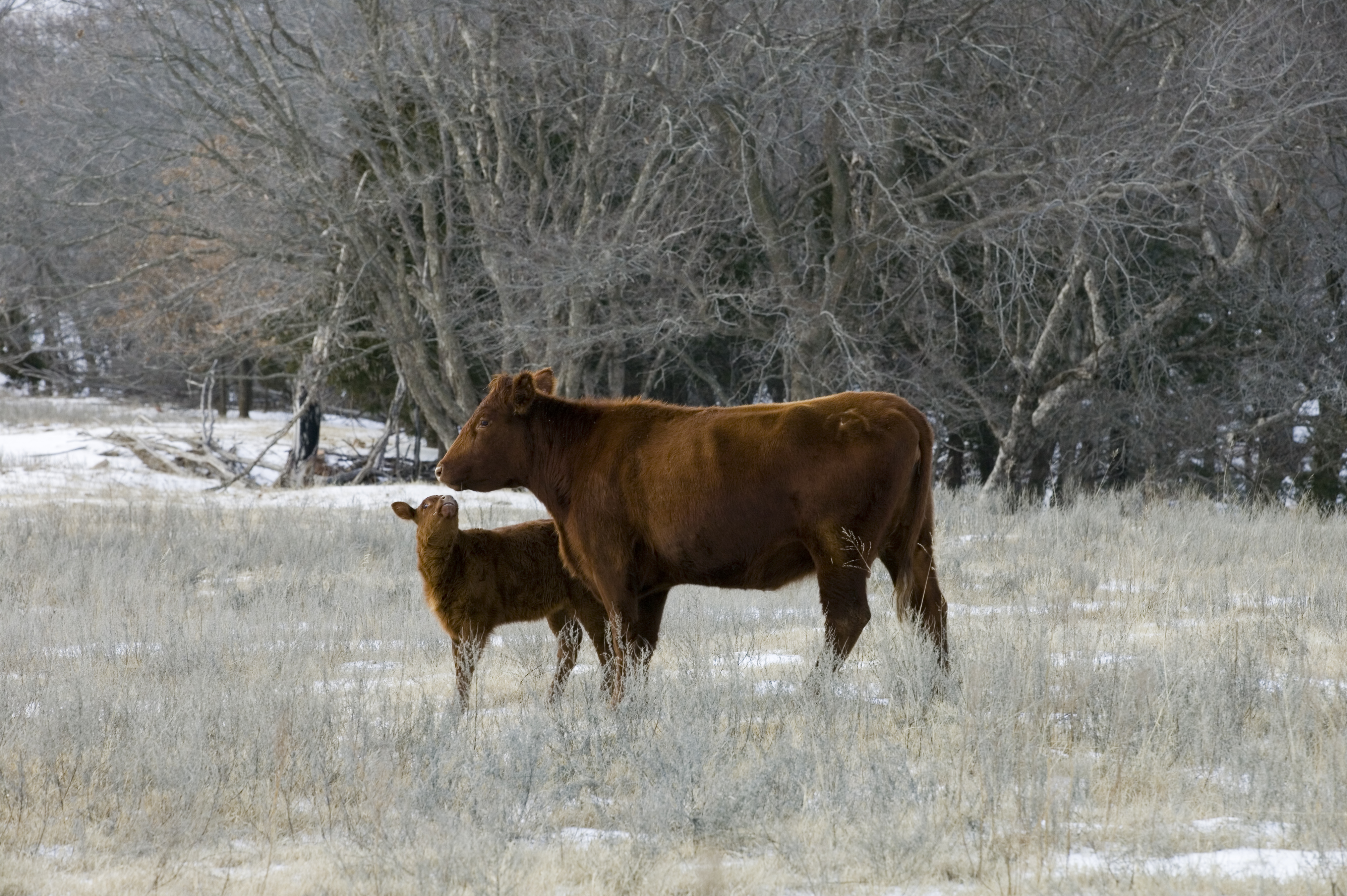
After this, for the next month, you will never be touched by a human hand. In fact, except for a few times in the next 6-8 months you will be left alone in a large pasture, living what most people would call a natural life (natural except that you have little need to fear predators).
Some ranchers may castrate males on the day they are born, cutting a whole in the scrotum sack and pulling the testicles out with her hands—for one semester as an undergraduate this was my job. Many farms will wait until you are a month or two old, and will place a tight band (think of a very small but strong rubber band) above your scrotum sack and your belly. Cutting off circulation, the band causes the scrotum and its testes to die and fall off the calf. A third method is the burdizzo, which crushes the cords above the testicles. The longer the rancher waits the more traumatic and painful the castration may be, and if you are not castrated you provide inferior meat and are more likely to injure ranchers and other hands.
Castration with an elastrator and burdizzo
)
If you are one of the breeds who naturally grow horns, sometime between one and seven months of age a paste will be rubbed on your ear to stop the horns from growing, preventing you from harming yourself and others. Or, you may be dehorned using other methods, like burning the horn buds with a hot iron (see video below) or an implement that simply “scoops”the horn and its root out of the head. Some ranchers use pain relievers and anaesthetics, but most do not. Though these procedures can be painful, the pain is temporary and arguably better than having your side pierced by the long horn of one of your peers.
Dehorning young calves with hot iron
)
It will likely be cold the day you are born, perhaps in late February or early March. It may strike you as odd that every other calf is about your age. Every cow conceived at about the same time because they were brought to estrus simultaneously. They do this by inserting a small device in the cow’s vagine, , releasing a device called a CIDR resembling a tampon that will remain in the vagina for seven days, after which it is removed. After the CIDR is released into the cow an injection of prostaglandin is administered. The cow will then go into ’heat“ (i.e., estrus) eight to eleven days after the CIDR is inserted (and one to three days after it is removed).(R1)
There are a number of different ways of detecting which cows are in heat on any given day. All livestock seem to exhibit some degree of homosexuality, and when a cow is in estrus female cows will often try and mount her, thereby revealing the cow is indeed in heat. A more common method is to take an cow not needed for breeding and inject her with testosterone (a male hormone) so that she behaves like a male. This testosterone-pumped female will then try and mount every cow in heat.
I once had a job where I rode a horse and penned a herd of cattle in the corner of a pasture. Then for fifteen minutes I watched this hormone-altered female as she tried to mount other cows, and would then write down the identification number of the cows being ridden. Later that day someone would artificially inseminate her. Other ranchers attach a device to head the hormone-altered female with something resembling a ball-point pen on the bottom. Then whenever she mounted another cow, as the bottom of her head rubbed against the cow’s back it would release ink. The rancher can then identify cattle in heat according to whether their backs are painted. Not all farms use such advanced technology.(O2) Some just release a bull into a herd of cattle and allow them to breed naturally.
It may seem odd that you were born at a time when there was little grass to eat, but the reason becomes obvious in a few months. Though you will nurse for perhaps eight months you will begin supplementing milk with grass when only a few weeks old. By June and July you are growing fast, constantly nursing and grazing, and your mother needs as much nourishment as possible to produce your milk. June and July also happens to be the time when grass (the cheapest feed) is most available. You were born in late winter so that grass is most abundant when it is most needed.
To help meet all your nutritional needs there is always a mineral block (or bowl of ground minerals) in the pasture, something you feel the urge to lick periodically. This helps ensure you have all your mineral needs met, but it might also contains some antibiotics which helps you stay healthy and grow fast. Water will always be available in the form of a trough fed by groundwater or a “tank” (a small pond).
What you did not recognize was that there was a smaller herd of cows you never encountered. Calves in this herd were born in the early fall, and thus needed food the most when it was cold and no grass grew. Around the time you were born these calves were being weaned and sent to the market for sale. Because there was no grass, the rancher provided these calves forage in the form of hay, so they had plenty to eat. Feeding hay is more expensive than grazing grass, and thus these fall-born calves are more expensive to raise. The rancher is aware of this though, and is also aware that because few calves are born in fall, when they are weaned there is a shortage of cows that age, allowing the rancher to receive a higher price for these calves than she will receive for you.
Figure 2—Cow eating hay

Back to your life, and the life of other calves your age. Only very rarely are you confined to small spaces. Most of the time you live in a large pasture with other calves and their mothers. You will not be confined to a barn unless you are very sick, and once the grass starts growing it does so in ample quantities. Life feels natural, like this is the way you were supposed to live. Your mother by your side always, peers to play with, and taken from one pasture to the next for both feed and environmental enrichment, you cannot imagine anything else you could possibly want.
By October you are more mature and independent, and though being weaned is stressful and you call and call for your mother, the anxiety doesn’t last long. To help you through this stressful time the rancher may supplement your forage (grass and hay) with a grain supplement, and the second you look sick health care is provided, usually in the form of an antibiotics. At birth you weighed around 80 lbs, but now you weigh 550. Two weeks after being weaned, it is now time for the second stage of your life, and the second stage of beef production.
Before going to the second stage of your life, let’s pause and consider what your life would have been like if you had been born a heifer, which is what females are called before they have their first calf, after which they are simply cows. If the rancher decided to keep the heifer for breeding purposes, the only time she will leave the farm is right at the end of her life. Until then, she stays on the farm and are kept in a pasture with other heifers until about fifteen months old. The gestation period for cows is nine months, so this will have her calving at about two years of age, in late winter. Some ranchers may simply place a bull in the pasture for natural breeding, but others may use artificially insemination (AI). Heifers have more trouble calving, so ranchers may use bull semen from sires known to give birth to smaller calves. The rancher will also keep a closer eye on heifers than the older cows.
After a month passes a larger ranch may use ultrasound to detect if she is pregnant, and if not, will either sell her for slaughter or breed her again. After she gives birth the heifer becomes a cow, and will be placed in the herd with her mother and other cows, and there she will continue to produce calves for two to five years—or up to ten years, depending on her reproductive performance and ability to provide milk. There will come an age when she is less productive than younger heifers, and the farmer will sell her for slaughter. After being sold in an auction she is transported and held in pens for a few more days, after which her muscle, though too tough for use as steaks, will be processed into a processed meat like ground beef or sausage.
Remember, you are not this hypothetical heifer. You are a steer, and it is now time to introduce you to your second stage in life. If you had been born a heifer the rancher decided not to retain for breeding, your life would have been the same as being born a male.
Stocker stage of beef production
After being taken to an auction and sold to a new owner, you are placed into a group of strangers of roughly the same size and age. For a few days you are held in small pens, and then transported in a cramped trailer to your new home. There you are held temporarily in pens, and perhaps another synthetic growth hormone will be placed under the skin of your ear. Just to be safe you might be administered some antibiotics in your feed, but only a short time passes until you are once again released into a large pasture.(A1,S2) It’s not exactly home, but very close to it.
Figure 3—Stocker cattle grazing on young wheat
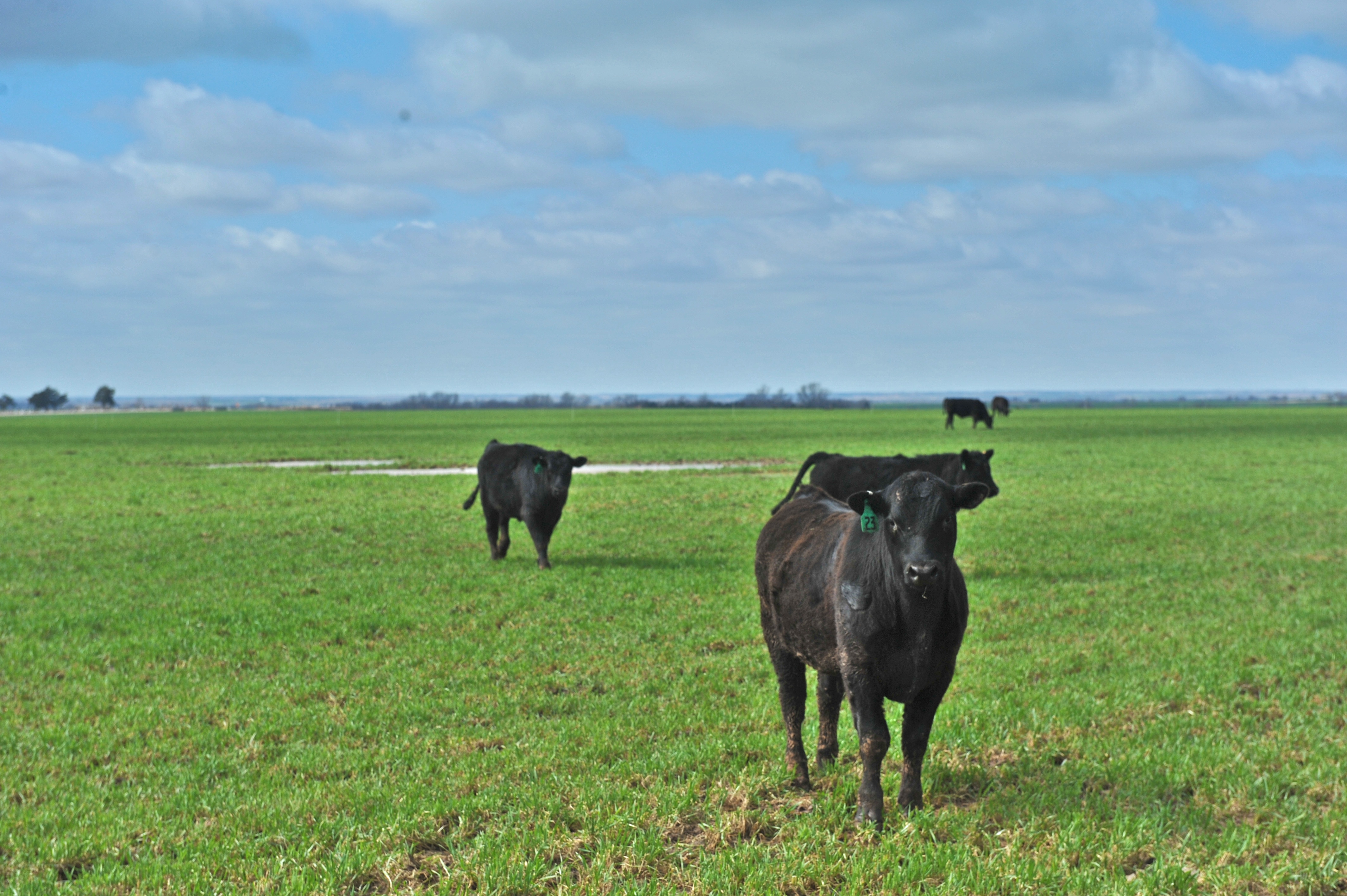
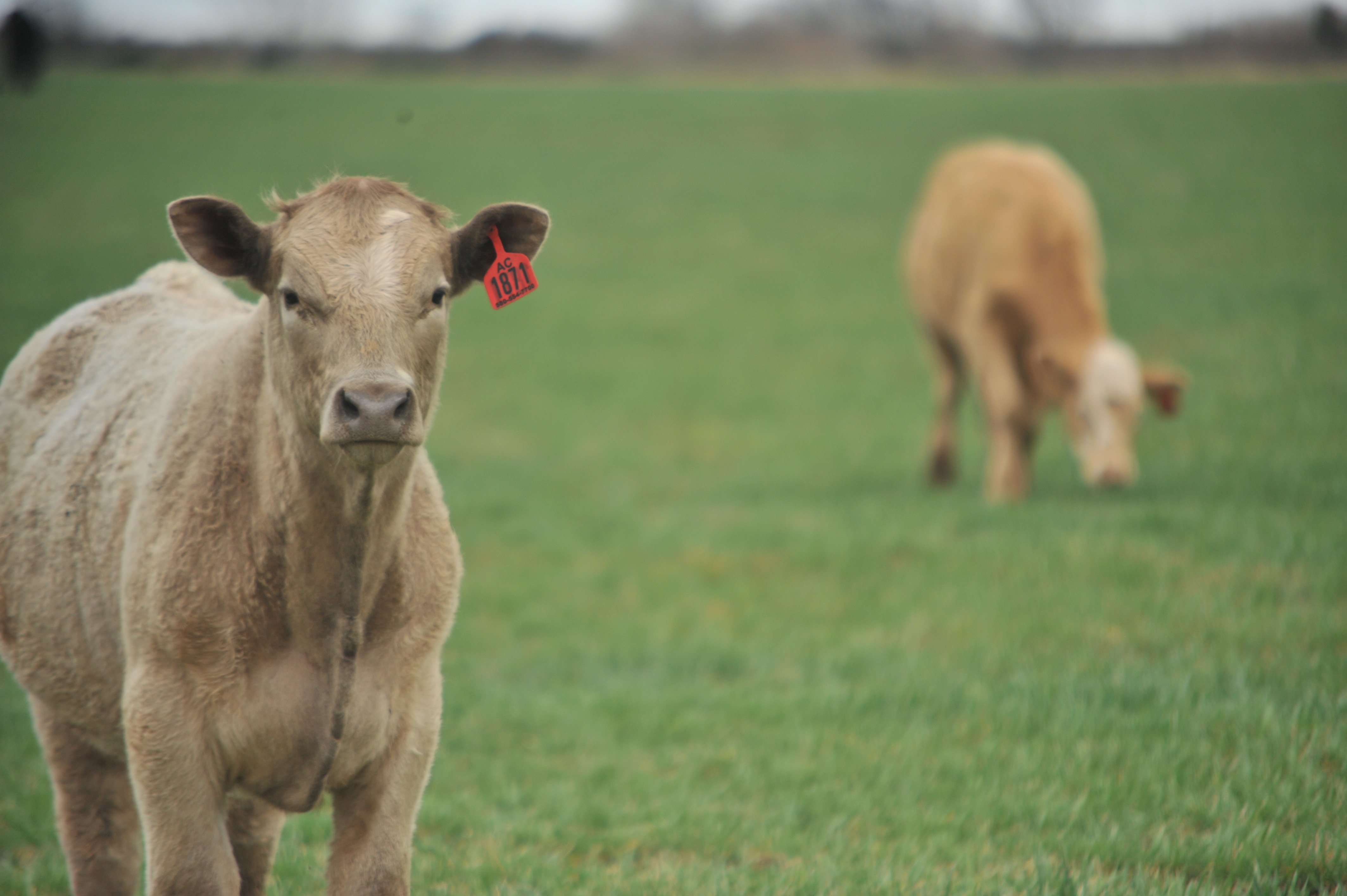
Now you are a stocker calf, and the first thing you notice is that the grass tastes different. You have tasted wheat for the first time. On this pasture the farmer is going to feed you and your new friends until late February, after which you are removed from the pasture so that the wheat can grow seeds for the farmer to harvest. Until then, you live the same natural, pleasant life of your youth. Rarely disturbed by humans. Ample grass. Wide open spaces. The company of others. The only time you are in-want is if the weather is particularly bad, as this pasture has no shelter, but those days are few.
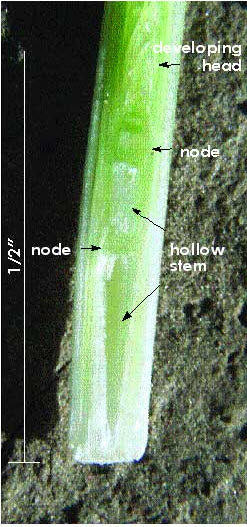
The farmer is likely to want to not only graze you on the wheat, but to harvest the wheat seed as well, and she can only do this if she removes you from the pasture sufficiently early to allow the wheat to form a seed. This is not a particular time of the year, but depends on how fast the wheat is maturing. The farmer will want to make sure you and your friends are removed from the wheat before the wheat develops its “first hollow stem”. This is when an ungrazed wheat plant begins growing a hollow stem just above the level of the plant roots and has reached a length of one-inch (so the farmer must make sure there are some wheat plants that are not grazed). At or before that first hollow stem is identified the farmer will want to sell you, except in cases where livestock prices are high and wheat prices are low, in which case you may be grazed on the wheat longer.(H1,T1)
This is your story of the stocker stage of production if you were raised in the south-central U.S. In other places you might be fed hay and grain during the winter, or perhaps grazed on winter wheat planted exclusively for grazing (and thus will not be harvested for wheat seed). Some farmers may use fescue or clover, which can grow well during colder seasons.
Figure 4—First hollow stem of wheat
Finishing stage of beef production
Your days of pasture are over. After being sold in an auction you are loaded on a large trailer with strangers and transported to your new home, referred to as a feedlot. Upon arrival, the first thing you notice is the complete lack of grass. The air is dry, much drier than your former two homes. This is no accident. The feedlot industry has deliberately moved to the south-central U.S. where the climate is generally pleasant and dry. With little rain the pens in which you live remain dry, and the arid climate helps promote cattle health. It is dusty at times, and you are constantly pestered by flies, but perhaps it is better than being in the damp cold. For perhaps the third time in your life a synthetic growth hormone may be inserted under the skin of your ear.
Figure 5—Feedlot
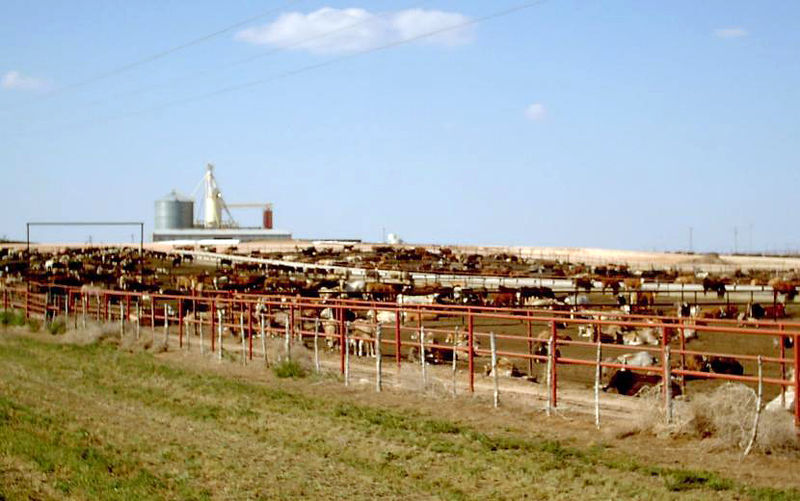
Though the pen that will be your home is not large, the animals are not nearly as cramped as in hog or broiler facilities. There is roughly 250 square feet of space per animal, ten times the amount provided to a hog. There is no shelter from bad weather, not even a shade for the summer heat, so you envy the pigs and broilers in that regard. Most every step you take is atop the urine and feces of other cattle, but because it is so dry at the feedlot the ground feels more like regular dirt than manure. The absence of grass concerned you at first, until you were given the most delicious feed imaginable. Only rarely in the past were you given corn, soybean meal, silage, or the like, but now it is available in almost unlimited portions and you absolutely love it. If given the choice between this feed and grass, you’ll take the feedlot ration anytime.(N3)
The feedlot diet is so different than the pasture that you must be slowly transitioned to it. If put on a high grain diet immediately the shock of the new feed will cause bloating and could very well kill you. During your first days the feed contained high amounts of forage, but over time the forage content falls and the grain content rises. It is in the feedlot’s interest to keep you alive, and the science of beef cattle nutrition has been almost perfected. As a result, less than 2% of the feedlot cattle experience bloating, and the mortality rate due to the feedlot diet is only around 0.05%.
Unlike chickens and hogs, cows rarely fight amongst each other, so injuries are seldom. If anyone in your pen gets hurt it is mostly likely due to riding, where steers mount one another as if they are going to breed. This is pointless, as you are a steer, and your pen-mates are all steers. There are other pens in the feedlot consisting of heifers who were not reserved for breeding, and so their life is nearly identical to yours. Even in the pens of heifers riding can be a problem. However, riding is easy to detect for both genders, and cattle identified as frequent riders are removed and kept separate from others.(N3)
Though you cannot taste it, your food at the feedlot will also have low levels of antibiotics, even when you are not sick. These ’subtherapeutic’ antibiotics administered to you reduces sickness, reduces the mortality rate, and helps you grow faster. At some point close to slaughter the antibiotics will be removed from your food, to make sure there are no antibiotics residues in the meat that you provide.(A1)
Months have passed. Though you miss pastures you also do not wish to stray too far from the feeding trough, where that scrumptious meal is delivered. At 20 months of age, and around 1,300 lbs, you are sold for slaughter, where your meat is made into steaks, briskets, ground beef, roasts, and the like.
Your life, which has been largely pleasant, especially compared with the lives of layers and hogs, will feed eight Americans.(E1,H1,N1,N2,N3,S1,T1)
Figures
(1-3) DASNR Kitchen Sink at Oklahoma State University.
(4) Provided by and used with permission from the Noble Foundation.
(5) By H2O (own picture/copied from en:Image:Feedlot-1.JPG) [GFDL (http://www.gnu.org/copyleft/fdl.html) or CC-BY-SA-3.0 (http://creativecommons.org/licenses/by-sa/3.0/)], via Wikimedia Commons

