
More than just dirt
If you want to frustrate a plant scientist, just refer to soil as “dirt.” This drives them crazy, and for a good reason. Thus far I have been discussing crop production as if the soil was a mere container to hold nutrients like nitrogen—a mere dinner plate on which food is placed. A dinner plate plate is a very poor metaphor, because the soil is not a substance, but an ecosystem.
Just as health experts are learning all the ways our bodies are influeced by the microorganisms in our intestine, plant scientists are discovering myriand ways that organisms within the soil affect plant growth. Plants often grow best when the soil is [almost] literally alive, containing a gallery of bacteria, fungi, worms, insects, and other critters. Tunnels dug by earthworms help aerate the soil. Some insects prey upon crop pests, thereby preventing crop damange. Some fungi settle on plant roots, helping plants communicate with one another by warning other plants of an approaching pest. (If the idea of plants communicating surprises you, you have underestimated the complexity of plants, which can not only communicate but have 15-20 different senses in addition to our five senses of smell, taste, sight, touch, and sound.(P1)) There are some microbes that assist plants in acquiring nutrients from the soil. A bacterium named Paenibacillus can prevent tomatoes from being contaminated with salmonella, and other microorganisms help assimilate carbon into the soil, thus releaving the atmosphere of greenhouse gases. There are bacteria living on the roots of legumes which snatch nitrogen from the air and convert it a plant-accessible for of nitrogen.
“Even though this looks static, like there’s nothing going on out there, beneath the surface there is something going on. All winter long, I’ve got worms and microbes preparing for the planting season.” He recalls seeing one estimate that untilled fields contain 30 million earthworms per acre, versus 3 million in the plowed soil.
—Johnson, Nathaniel [reporter] and David Ausberger [farmer and interviewee]. March 13, 2014. “Un till: An Iowa farmer finds that
less (plow) is more (profit)” Grist. Accessed March 14, 2014 at http://grist.org/food/un-till-an-iowa-farmer-finds-that-less-plow-is-more-profit/?utm_source=syndication&utm_medium=rss&utm_campaign=feed.
We should recognize that microbes are not always beneficial for crops. Sometimes they help the pests that damage crops, like the bacteria living inside the Colorado potato beetle. When the beetle lands on potato and begins munching, this bacterium tricks the potato plant to think it is a microbe attacking it, not a herbivore. As a result the plant tries to defend itself against a microbe, not the beetle, and so defends itself poorly.(S3) The job of agricultural scientists is to engineer the cropping strategy so that most of the microbes are indeed on the side of the crops, and therefore, of humans also.
Figure 1—The Soil Food Web

Many of these beneficial organism populations are reduced by chemical fertilizers, although thus far these affects seem to be small. In cases where the effects are large, one can either reduce use of chemical fertilizers or replace it with manure or compost. There is also the option of retaining the use of chemical fertilizers but add other technologies that help compensate for the loss of microbes. For instance, the aeration of the soil normally performed by earthworms can be done with mechanical aerators instead. If fertilizers are killing large numbers of microbes there are companies like Terra-One that sell fertilizer supplements to replace these populations (gardnerers have been purchasing microorganisms for decades).
Healthy soils are high in organic matter, as it helps prevent erosion and retain moisture. Soils low in organic content can be improved by applications of manure or compost, or by the adoption of no-methods, where the ground is never plowed and the roots formed by plants remain in the soil, undisturbed.
Diversity under the microscope
Some worry that because so few crops are planted on most U.S. cropland, and those crops are so genetically similar to one another, that one abnormally large infestation of pests could cause massive yield losses. It turns out that we should be worried about the genetic diversity in the soil ecosystem as well, as a healthy soil has more genetic diversity in its microbial communities than the plants and animals it supports. Every decision a farmer makes can impact the soil ecosystem. For example, highly plowed land tends to possess smaller populations of Verrucomicrobia. These bacteria are particular good at helping plants survive in low-nutrient conditions, and can make it more difficult for fertilizers to provide plant nutrients.(S1)
Video 1—All the critters within the soil
Just as some microbial colonies must be allowed to thrive naturally to preserve soil health, other microbes can be introduced into new areas to aid a degrading soil. Cropland under irrigation tends to suffer from salinity, as ground water contains levels of salt not present in rain. This detracts from crop production, but some areas have no choice but to use irrigation. One specific problem with high salt levels is that it prevents the formation of bacteria on legume plant roots, bacteria which can convert atmospheric nitrogen into a plant-accessible form. Researchers are optimistic that this problem can be mitigated by introducing bacteria from the Pseudomonas family into the soil.(A2,C2,,E1,W2)
Soil erosion
Soil may not be dirt, but a field that loses most of its topsoil essentially becomes dirt, of little use in growing plants. Not only do the nutrients wash away with the topsoil, but the ecosystem goes with it. The dirt underneath topsoil has a different texture, and is usually less suitable for crop production. The point is that the topsoil is a resource, and we must conserve it the best we can. However, it is a lamentable fact that it is nearly impossible to raise crops without some soil erosion. Erosion is a natural part of life, even in the absence of humans, but crops are raised by plunging plows, cultivators, and/or planters into the ground, loosing the soil and leave it exposed, making it that much easier for rainstorms and winds to take it away.
Erosion can be reduced to low levels by adoption of no-till planting methods where seeds are planted directly into an unplowed soil and weeds are managed using pesticides. The creation of transgenic soybeans, for instance, has made it much easier for farmers to control weeds with the herbicide Round Up, thus encouraging farmers to abandon the plow and adopt no-till methods which can reduce erosion by as much as 90%.(N2) Of course, this means greater pesticide use and reliance on transgenic crops, which some oppose. The point is that the soil is a valuable resource that must be protected, but such protection always comes at a cost.
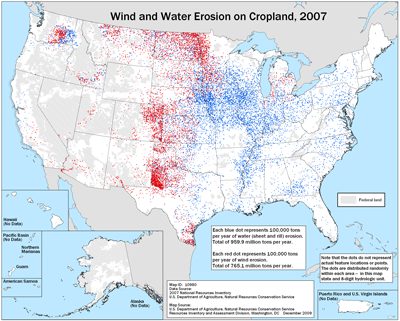
The figure below shows that erosion is indeed a national problem, but we are also doing better, as less soil was lost in 2007 compared to 1982. A major reason is indeed the adoption of transgenic crops, the pesticide Round Up, and no-till production method allows the plant roots to retain the soil even in the most furious of winds and heaviest of rains..(H4)
When we debate whether we want to use synthetic pesticides and transgenic crops, we are also debating how much soil erosion we can tolerate.
Figure 2—Soil erosion in 1982
(Blue and red dots represent 100,000 tons of annaul erosion due to water and wind erosion, respectively)
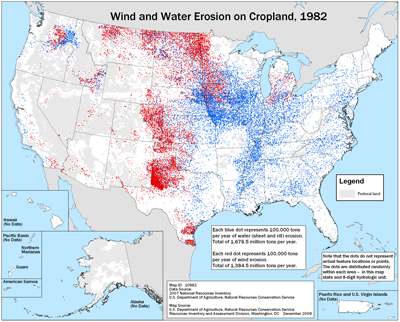
Figure 3—Soil erosion in 2007
(Blue and red dots represent 100,000 tons of annaul erosion due to water and wind erosion, respectively)
Figures
(1) National Resource Conservation Service. Soil Biology Primer [website]. United States Department of Agriculture. Accessed May 10, 2014 at http://www.nrcs.usda.gov/wps/portal/nrcs/main/soils/health/biology/.
(2) and (3) National Resource Conservation Service. Soil Biology Primer [website]. United States Department of Agriculture. Accessed May 10, 2014 at http://www.nrcs.usda.gov/wps/portal/nrcs/detail/national/technical/nra/dma/?cid=stelprdb1041887.

