
Hog production and the animal welfare controversy
Americans are conflicted about how they believe animals should be raised. Most grocery stores sell both cage and cage-free eggs, and but only 5% of sales are of the cage-free variety. Yet when Californians were asked to vote on whether it should ban cage egg production, 63% of voters approved the ban.(N1) Californians seem to hold one opinion at the ballot box and another at the grocery store.
Similarly, in my research consumers tell me they don’t like the crates used to house pregnant sows, and when given the opportunity ban it in a voter initiative, the ban is always approved. This happened in Florida, Arizona, and California. Yet it is nearly impossible to find pork advertised as being produced without the crates. If consumers are really willing to pay the cost of crate-free pork then we would expect pork producers to profit from that demand. As with eggs, it seems like consumers say one thing when they vote but something else when they shop.(N1)
Part of my research involves performing scientific experiments to determine consumers' willingness-to-pay for cage-free eggs and crate-free pork. After designing scientifically controlled experiments and spending thousands of dollars in grant money, the data say most consumers are indeed willing to pay more than the additional price necessary for farmers to sell more animal-friendly foods. Again, such foods have a very low market share, so what gives?(N1)
Perhaps this is because the average person doesn’t understand the animal welfare issue well, and when they are in the voting booth or participants in my experiments they are thinking mostly about the animals’ welfare, while in the grocery store they are thinking mostly about their budget? I doubt that animal welfare considerations even register in the mind of most consumers in the grocery store. However, when they vote on an animal welfare issue or participate in my experiments an external force is making them consider it. Consider it, they should, even in the grocery store, because farmers are placed between a rock and a hard place. One the one hand voters tell them to raise animals differently, but if they do, those same voters won’t pay the higher price the farmer needs to raise them differently. Farmers cannot fulfil consumer demand for food until we make our mind up about what we foods we wish to eat.
The willingness of consumers to pay higher prices in return for better animal care is difficult to judge. When people are asked whether they would pay premiums for animal-friendly products they say they will, but when asked about the importance of various social issues the well-being of farm animals is ranked slightly lower than food prices, as shown below. Moreover, both low food prices and animal welfare are considered less important than the financial well-being of U.S. farmers.
Table 1—Importance of various social issues by a representative sample of Americans(P1)
Social Issue |
Importance Score (higher number indicates greater importance) |
| Human poverty | 23.95 |
| U.S. health care system | 23.03 |
| Food safety | 21.75 |
| The environment | 13.91 |
| Financial well-being of U.S. farmers | 8.16 |
| Food prices | 5.06 |
| Well-being of farm animals | 4.15 |
In a previous article / video you were taken on a virtual tour of the standard hog production facility, where hogs are raised completely indoors in cramped spaces, and where pregnant sows are housed in gestation-crates. For this reason the conventional hog farm is described as a confinement-crate system. Is this the best system in terms of animal welfare? If not, what type of farms provide hogs a better life, and if we purchased pork from these farms, how much more would we pay?
This lecture seeks to compare the confinement-crate system to two alternatives, one of which is a small tweak of the conventional system and another which is anything but similar.
Measuring animal welfare
As one might imagine, measuring the happiness of a pig is a daunting task. Hogs cannot tell us how happy they are, but even if they could, as it is in the case of humans, it would be difficult to determine exactly what their answers imply.
In one sense measuring animal welfare is easy, for hogs are relatively simple creatures and we feel we have a good handle on what makes them happy. If they are healthier, they are happier. If they have more space to move, they are happier. If they have straw to root in and make a comfortable sleeping area, they are happier. Of all the amenities that benefit the hog we can group them into biological needs and behavioral needs. Nutritious food and health care improves the health of the sow and is thus a biological need. Sows in better health are more likely to conceive and reproduce, so the hog industry tends to concentrate mostly on biological needs when discussing animal welfare.
Livestock industries sometimes argue that they treat their animals humanely because, if they did not, it would cost them money. Profitability and welfare go hand-in-hand, they argue. While it is true that happier hogs will usually be more productive, a farmer’s objective is to maximize profits, not the farm’s per-sow productivity, and the two are often but not always the same. For example, a farmer may be able to increase her profits by placing more sows in the same barn. The stress of the cramped quarters may reduce the productivity of each sow, but the farm increases its overall profits because it is able to raise more sows and thus have more piglets born and raised for meat. Also, there are many behavioral needs a farmer could provide, like straw for rooting, and though it would make the sows happier the increase in productivity is not worth the high cost of provision.
Our producers take care of their animals, and we know that an animal that isn’t treated well doesn’t produce.
—Dewald, Scott. Vice-President of the Oklahoma Cattleman’s Association.(A1)
Whenever one biological or behavioral need is better provided without decreasing the provision of some other need, most animal scientists will agree that animal welfare is enhanced. The problem is that most of the time a tradeoff between different needs is unavoidable. When farmers take sows out of small individual cages the greater mobility is a positive development, but the sow is then usually place in groups with other sows where fighting, injury, and competition for food takes place, all of which can reduce welfare. Is the greater mobility worth the greater injury? It is difficult to tell, and most animal scientists look at this tradeoff and argue that it is impossible to determine whether the benefits outweigh the costs, leaving us unsure of whether the hog’s life is improved.
Other times, animal scientists in the U.S. seem to place more emphasis on biological rather than behavioral needs. They might then argue that, after removing the sow from a group-pen and placing her in a small cage, if the sow is in better health and is more productive then she must have more of her biological needs met, and is therefore happier. However, there are other scientists who contend that behavioral needs are important to, and hogs do desire the ability to at least turn around (which they cannot in a gestation-crate).
There is one study ambitious enough to evaluate tradeoffs in animal welfare while accounting for both biological and behavioral needs.(B1,B2) This study uses a mathematical model, where a farm is described according to 37 different attributes. The importance of each attribute to sow welfare is then derived from statements made in the scientific literature. After a farm is described according to these 37 factors, the model (referred to as the SOWEL model) then computes a single number corresponding to the animals’s overall welfare. This study is particularly useful because it accounts for an animal’s behavioral needs, as the average American indeed believes that these behavioral needs are just as important as biological needs.(P1)
Table 2—Importance of various social issues by a representative sample of Americans(P1)
Livestock production practice |
Importance Score (higher number means the practice is perceived by consumers to be more important for humane livestock production) |
| Receiving ample food and water | 38.43 |
| Receiving treatment for injury and disease | 29.05 |
| Being allowed to exhibit normal behaviors | 8.01 |
| Allowed to exercise outdoors | 7.95 |
| Protected from being harmed by other animals | 5.90 |
| Provided shelter at a comfortable temperature | 4.43 |
| Allowed to socialize with other animals | 2.76 |
| Raised in a way to keep food prices low | 1.75 |
| Provided with comfortable bedding | 1.72 |
Because this study is the only one I know of that can be used to objectively measure animal welfare, and because it was published in the prestigious Journal of Animal Science, I will rely on this model to evaluate various alternatives to the confinement-crate system. However, it should first be noted that not all scientists will agree with the SOWEL model, and that the model only accounts for the welfare of the sows: not nursing pigs, pigs in the nursery, or pigs at the finishing stage of production.
I wish to stress that while the SOWEL is a useful device for determining the well-being of sows, its output should not be interpreted as a fact. The numbers are instead interpretations of other facts found across a wide range of scientific publications, and just because something is based on facts doesn’t mean that it is a fact.
Confinement-pen system
In your virtual tour of the confinement-crate system you saw how pregnant sows were kept in crates so small the sow could not turn around. She remained in this crate and on a hard, slatted floor, all day, every day, until she was ready to gift birth, after which she was transferred to a farrowing-crate. Then after her piglets are weaned she is moved back to the gestation-crate. A sow might spend two-thirds or more of her life will take place in the gestation-crate.
It is this restrictive and barren crate that disturbs consumers and animal advocates the most, which is why various bans have been placed on their use in Florida, Arizona, Oregon, Colorado, California, Maine, Michigan, and Ohio.(N3) Can a farm maintain the confined production system without gestation crates? What does a conventional farmer do if she lives in a state where gestation-crates are suddenly banned? The answer is the confinement-pen system, which is virtually identical to the confinement-crate system except that instead of housing sows in individual stalls, they are kept in groups.
Figure 1—Gestation-crates (left) and group-pens (right)
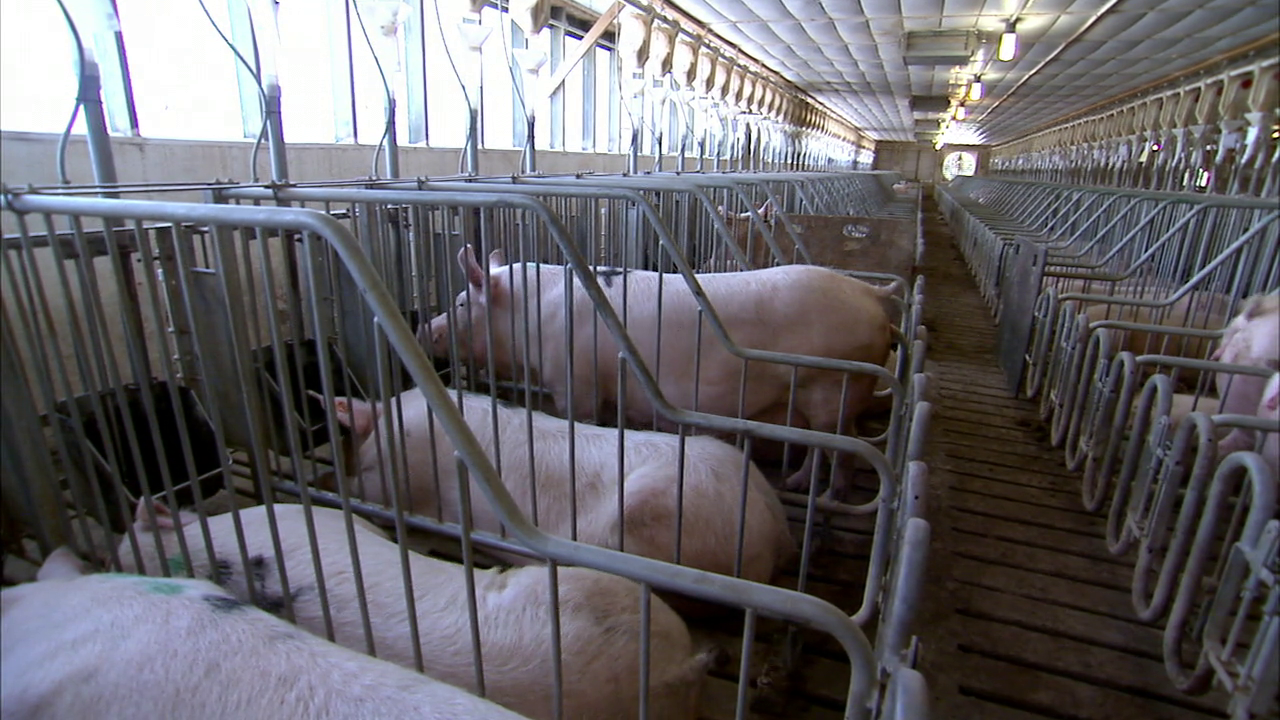
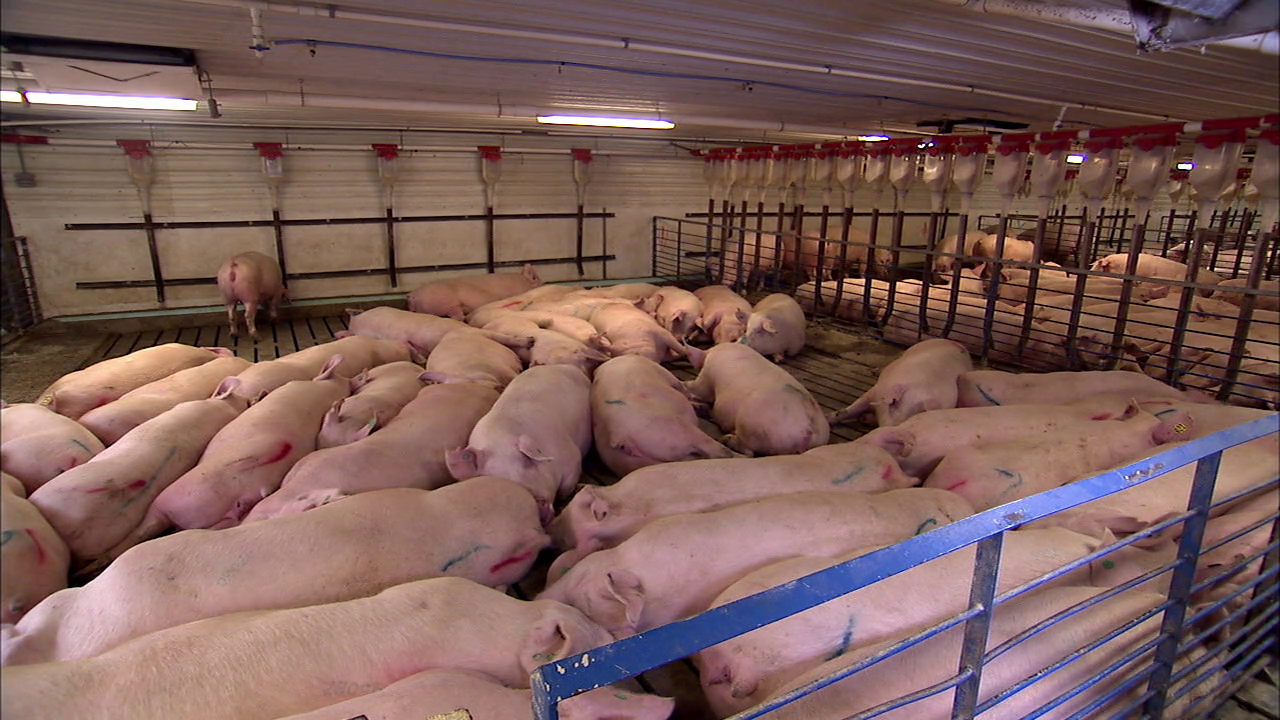
Group-pens are what the name implies: sows are placed in small groups of similar-size sows. No longer restricted by crates, sows are free to walk and turn around. They are also given more total space per sow. Each had about 14 square feet in the crate system but now have 16-24 square feet. With more room and mobility they can better find comfortable resting places.
There are some drawbacks to the group-pens. It is still a barren cage with no material to root in and no areas to explore. Sows are not always kind to one another, and with so many bored sows in a cramped, barren cage they can inflict injury upon another. Moreover, if they are fed as a group the dominant sows may take food from more submissive ones, causing some sows to eat too little and others to eat too much. I know that some farms using group-pens use individual crates where sows can enter and exit freely so they can eat alone, but I do not know the extent to which this practice used. Farms that do use such technologies will reduce the drawbacks of group-pens, so much so that group-pens might then be unambiguously better for the sows.
What do animal scientists say about animal welfare of pregnant sows in crates versus group-pens? Because there are disadvantages to each, and because it depends on how the group-pens are designed, they are reticent to make blanket statements about one being better than the other. My research with consumers suggests that consumers definitely prefer the group-pens,(N2) but the consumers are probably unaware of the extent to which sows may injure one another in groups.
The SOWEL model evaluates two variates of the group-pen systems, referred to as the ESF and the free-access system. The model finds that these alteratives are indeed superior in terms of animal welfare. This implies that the bans on gestation-crates in select states of the U.S. could improve the welfare of sows in those states, assuming farmers find a way to limit competition between sows for food. Because the nursery and finishing stages are identical in the confinement-crate and confinement-pen, these systems would then be considered more humane. Let me stress again that the previous sentence is not a fact. The SOWEL model is just one way of measuring welfare, and it could be that an equally valid model could arrive at a different conclusion. The SOWEL model provides scientific judgements, not scientific facts.
Figure 2—Welfare score for sows in various farm systems (higher score means happier sows)
Source: Bracke et. al. 2002. Journal of Animal Science. 80:1819-1834.

Shelter-pasture system
Some farmers have turned away from modern hog production technologies and embraced the farms of a century ago. In this system hogs have frequent access to both shelter and pasture. They can dig, play in wallowing holes, explore, and do all the activities that they naturally crave to perform. During cold weather they may be confined inside a barn, but with much more space per pig and constant access to bedding material, such as straw, mulch, or sawdust for the animals to dig in and create a comfortable resting space.
Figure 3—Farrowing hut in a shelter-pasture system
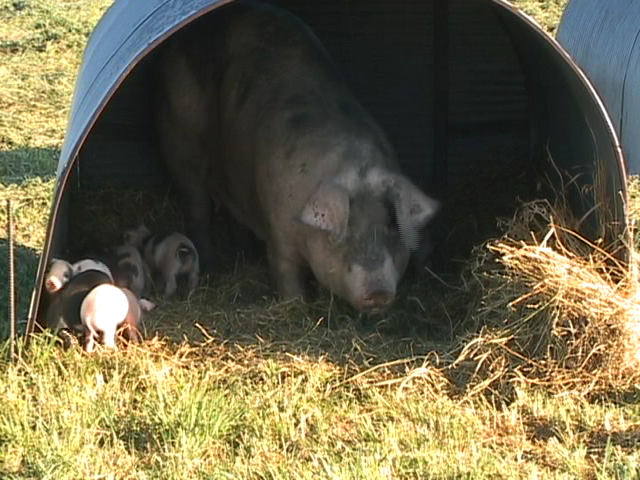
Figure 4—Outdoor accesss in a shelter-pasture system
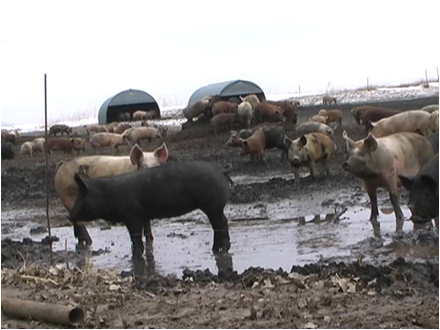
The sows give birth inside a private farrowing hut, which is a half-cylinder structure just tall enough for the sow to enter. Straw in the hut provide warmth and comfort (as the bottom layer of the straw composts the microbial activity generates heat), and the sow and her piglets can leave and enter the hut freely. While it seems likely that the piglets will have a more pleasant life from the time of weaning till slaughter, the absence of a farrowing-crate means that more mothers will crush and/or neglect their offspring. Mortality rates of piglets will be higher than the confinement-crate system. Moreover, since the hogs have greater contact with other hogs and their feces, disease and parasites may be higher in the shelter-pasture system.
Because there is less boredom in the shelter-pasture system there is no need to dock the tails of the pigs, nor will there be much fighting among the sows. Piglets would not be weaned as early as they are in confinement systems, but would be allowed to nurse for up to six weeks.
Figure 5—Pasture access in a shelter-pasture system
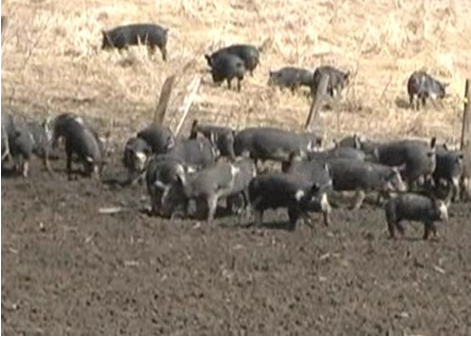
Overall, the SOWEL model ranks the shelter-pasture considerably higher than the confinment-crate or the confinement-pen system in terms of animal welfare. The SOWEL model may only account for the sows’s well-being but it seems likely that the results would extend to hogs in the nursery and finishing stages as well. The model therefore rates the enhanced life of the sow greater than the higher mortality rates of her young. Again, this should not be interpreted as a fact. Some animal scientists might disagree, and it is questionable whether the farms selling shelter-pasture pork would abide by the system guidelines in the SOWEL model. Still, if we want a scientific assessment of the various hog production systems, the SOWEL model is the best source available.
Figure 6—Welfare score for sows in various farm systems (higher score means happier sows)
Source: Bracke et. al. 2002. Journal of Animal Science. 80:1819-1834.

What is the price of happier hogs?
Suppose that you agree with the SOWEL model and decide that you would be willing to pay a premium for pork produced using a confinement-pen system, and an even higher premium for pork produced in a shelter-pasture system. How high might this premium be? This is not an easy question to answer.
My research suggests that it costs only about 2% or $0.06 more per retail pound of pork using a confinement-pen system relative to a confinement-crate system (the average price of retail pork is around $2.80 per lb). This means that if 100% of the higher costs experienced by the farmer—and only those costs—were passed onto consumers in the form of higher prices, Not only does this cost seem relatively low, but in experiments consumers have shown they will pay almost $0.50 more per lb, so it would seem as if the hog industry could make higher profits by replacing gestation-crates with group-pens. So why don’t they? Again, the answer probably has to do with the fact that people in my experiments behave differently than they do when shopping at the grocery store.(N1,S1)
Shelter-pasture pork should result in even higher prices, as it costs the farmer not 2% more per lb of retail pork to produce, but at least 5% more, which translates to $0.14 per retail lb. This $0.14 is probably a lower bound, as it represents the costs incurred by farmers who have already chosen to raise shelter-pasture pork. These are the individuals who possess the unique skills needed to raise hogs in such a setting, and possess the desire to. In contrast, asking North Carolina hog producers to convert to shelter-pasture systems is asking too much. North Carolina is the second-largest hog producing state, but only became a major hog producer after the age of confinement. Their hog farmers never transitioned from shelter-pasture systems to confinement systems, so would have little idea how to transition back to such a system. Most of these producers only know how to handle hogs in a confinement-crate system and probably lack the desire and land needed to produce shelter-pasture pork.
It is difficult to find actual prices from farms using a confinement-pen or shelter-pasture system, so instead I’ll refer to a pork product somewhere between the two. The Whole Foods grocery store uses a rating system established by the Global Animal Partnership to communicate the level of animal welfare in its food. During the December of 2013 I visited Whole Foods to purchase pork raised in what they call a “Step 1” system. Such farms use group-pens instead of gestation crates, but also provide other amenities like even greater space allotments and bedding on 75% of the floor. The hogs are still raised indoors, but one with greater mobility and environmental enrichment. Since the Step 1 system goes beyond the confinement-pen system but not as far as the shelter-pasture system, if the additional costs at the farm were passed onto consumers—and only those costs—we would expect the price of Step 1 ham at Whole Foods to be around 2% to 5% higher than pork raised in confinement-crate systems elsewhere, but the actual premium Whole Foods charges is much, much higher.
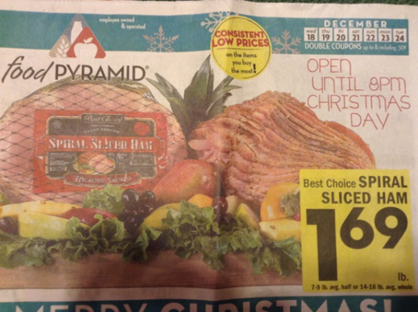
The ham I purchased at Whole Foods sold for $4.49 per lb, an enormous price compared to Walmart, which was selling ham (undoubtedly from a confinement-crate system) at the same time for only $1.69 per lb.
Figure 7—Label for confinement-pen pork at Whole Foods
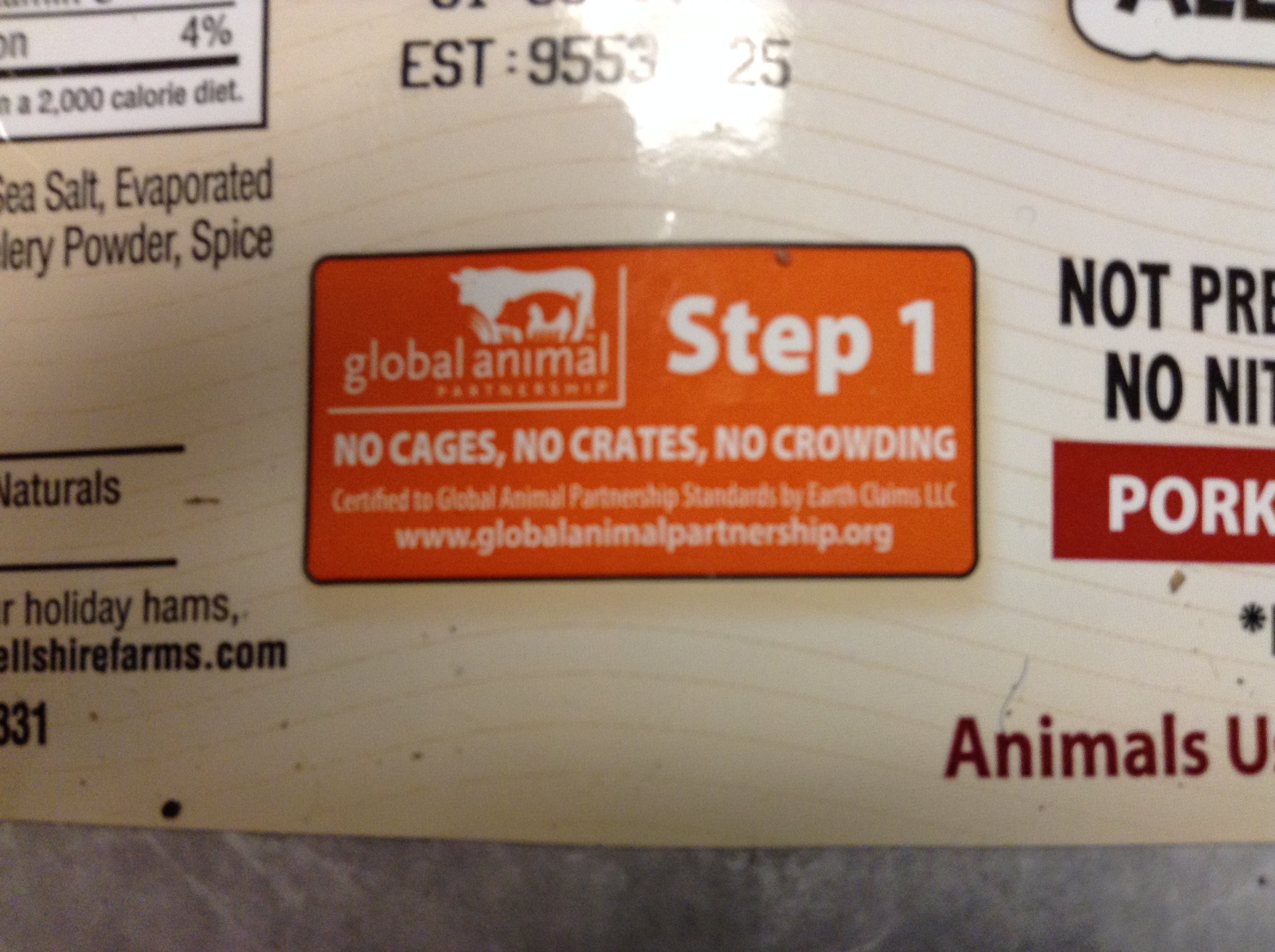
Figure 8—The price of confinement-pen pork at Whole Foods in December of 2013
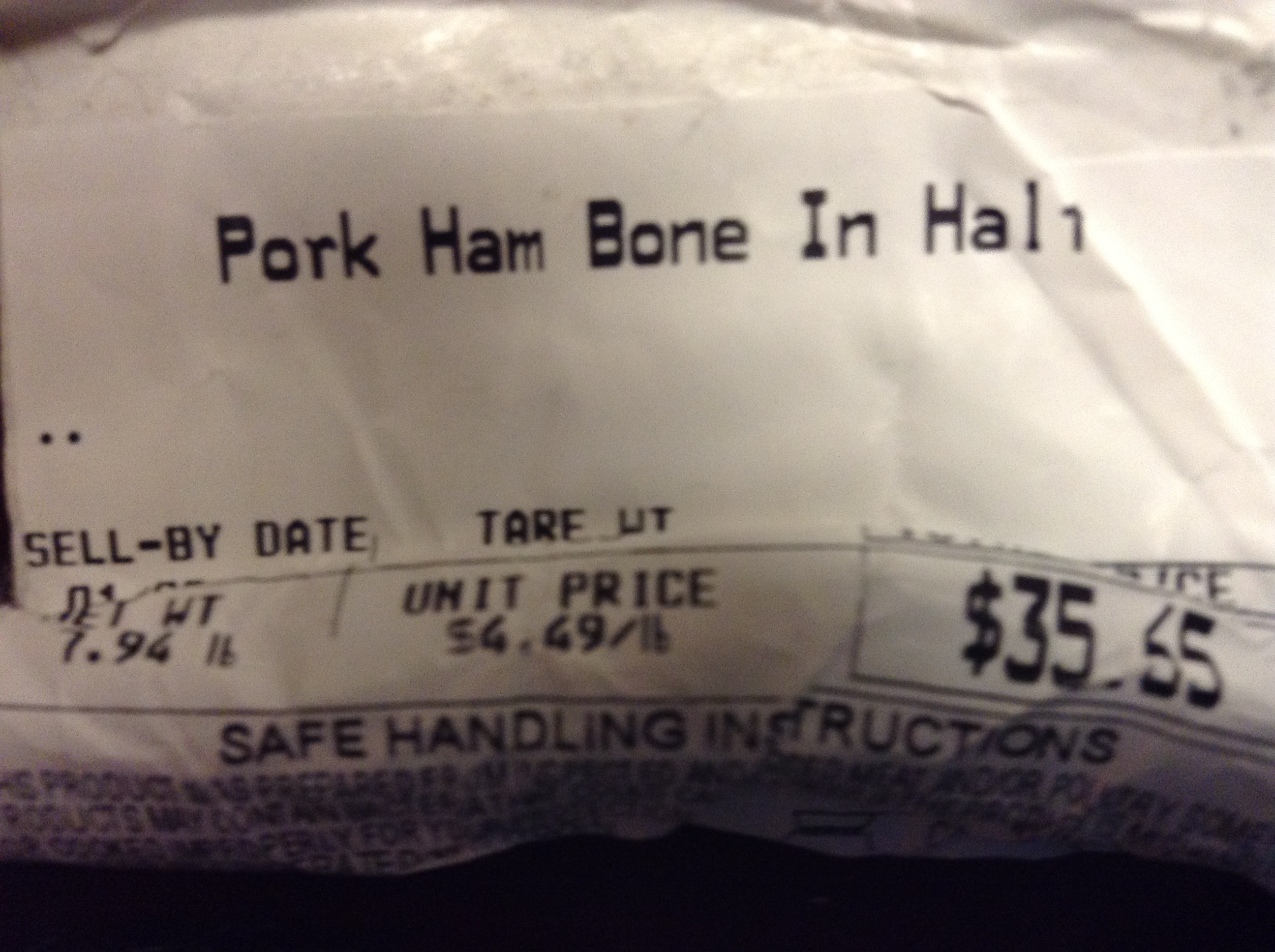
Figure 9—The price of confinement-crate pork at Walmart in December of 2013
Why does Whole Foods charge so much? One reason might be: because they can. Perhaps Whole Foods shoppers are less sensitive to high prices than Walmart? Or, perhaps consuming wanting animal-friendly foods will only believe animals are treated well if the price premium is large, in the same way that we are skeptical that a wine is truly a “fine wine” unless its price is high?
Another reason might be an inefficient distribution system. In the lecture Vertical Coordination it is demonstrated that most of the cost of food production occurs not at the farm but at the farm input sector and in the distribution of food (wholesale and retail sectors). I doubt there is any company who can connect farmers with the rest of the country more efficiently than Walmart. It probably costs Whole Foods much more to connect the few confinement-pen producers with the nation, and that higher cost might be the main factor behind their high prices.
A final reason is the fact that this particular ham was also produced without using antibiotics, so the farmer’s cost of production was higher for these other than those related to animal welfare.
The future of hog production
It is unclear what hog production may look like twenty years from now. Although many states have indeed placed bans on gestation-crates, most of the major hog producing states are insulated against the voter initiatives and lobbying by animal advocacy organizations, so the crates may still be used in twenty years.
On the other hand, gestation-crates are very unpopular with citizens, even if they still buy pork made from gestation-crates in the grocery stores. Animal advocacy organizations have learned they can pressure organizations like grocery store chains, fast food restaurants, and universities into agreeing not to purchase pork made with gestation crates.
Smithfield Foods is the largest pork producer in the U.S., and after feeling pressure to adopt group-pens and after studying such systems in Europe, they have already taken measures to convert some of the farms it owns to group-pens. While this conversion does not apply to the farms it contracts with (where most pork production takes place) this commitment to increasing the use of group-pens is a sign that in fifty years gestation-crates may a historical artifact. The word “may” is stressed.
What is the future? I must plead ignorance, but I do hope that this lecture has helped you better determine your own food preferences.
Figures
(1) Courtesy of the Oklahoma Pork Council.
(2) Reprinted with permission from the Journal of Animal Science.
(3) Used with permission by an anonymous farmer.
(4-5) Personal photographs.
(6) Reprinted with permission from the Journal of Animal Science.
(7-9) Personal photographs.

