
A tour of the confinement-crate hog production system
Humans have been raising hogs and eating pork for millennia, and in almost every way you can imagine. Ancient Egyptians seem to have raised some of their hogs in confinement like we do today. In colonial America hogs were let loose on their own to find their own food and water, and the farmer would then search for them once or twice a year to harvest them. In this sense pork in colonial America was almost free. In 19th century New York there were “street hogs” that belonged to no one. They were allowed to wander throughout the city on their own, as they provided a service of eating trash others discarded. For instance, a butcher might throw the remains of his carcass behind the shop, knowing the hogs would reduce the carcass to mere bones. In Egypt today, the Christians receive trash from Cairo, and after they remove recyclable items like plastic and glass, they also remove discarded food which they feed to their pigs, thereby converting trash pork, and the pork manure to fertilizer.(N1,O1)
Today in the U.S. hogs are raised almost exclusively indoors, like the farms we will see in this lecture. As early as 1913 farmers were experimenting with raising hogs on concrete floors and inside buildings. The idea didn’t really take off until the last 50 years, and today, very few hogs will touch the earth.
If there is one thing you should know about hogs it is that they are difficult to handle. They are generally not mean, but they are clever and stubborn. If you want to herd them to a destination the best way is to lure them with food, as you can’t herd them like one would cattle or sheep. Fencing them in an area is difficult, because they will constantly scan the fence for weaknesses and, when one is found, they will escape. Even when the fence is strong they will scratch themselves by rubbing up against it, and this will eventually break the fence if not constantly maintained. One can use an electronic fence, which shocks them if they touch a wire or very heavy steel panels. A wooden fence is not strong enough and has too many holes.
Hogs are destructive. Turn them loose into a smooth, verdant field and they will immediately start digging holes, turning it into a World War I no-man’s land.
That is why you will lots of heavy steel on these farms. You will also see them confined to rather close quarters and always on a solid floor. Anything remotely weak in these buildings and they be quickly destroyed by the animals. Moreover, handling hogs always creates stress, so these buildings are designed so that the animals rarely need to be moved or handled directly by the workers.
A hog’s life: birth to weaning
Your mother may be about half a year when she gave birth to you in her first litter, or she may be over a year old and having her third or fourth litter. Chances are, she never mated with a live boar. Instead, your father’s semen was purchased by the farmer to impregnate your mother, and then three months, three weeks, and three days later, you are born.
You are born a female piglet, along with eleven siblings. Because you are born in a barn where humans have easy-access to your mother, you might be born into the hands of a farm worker who cleaned you off, made sure you were healthy, placed you under a heat lamp, and then tended to your siblings. Unlike humans, you can walk almost as soon as you are born, and soon you find your way to your mother’teat, and you begin nursing. Soon you learn that you can approach the heat lamp when you are cold and leave the lamp when you are hot.
Figure dd—
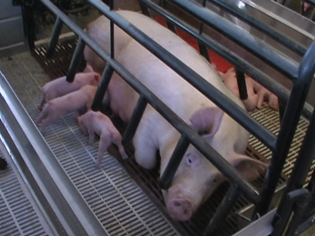
Almost every time you want to nurse, you can, for your mother is confined to a crate slightly bigger than herself. She cannot leave. She cannot even turn around. Much of the time she is lying down. Even if your mother doesn’t want to nurse you, she must. Some mothers abandon their young, but she cannot. A few even cannibalize her young, but even if she wanted to it would be hard for her to get to you unless you just happened to wander close to her mouth.
Most of the advantages of being raised in a confinement-crate system you will taken for granted because you won’t experience life without them. Because the building will always be at a comfortable temperature. You know neither cold, nor hot. Neither the cold rain, nor the hot humidity of July. Were it not for the farrowing-crate, which forces the mother to lie down slowly, you are likely to experience the fear of almost being—or actually being—crushed by her large body.
Because of your excellent health you are unlikely to experience the misery of disease or parasites. The slatted floors underneath your family allows feces to drop below, preventing spread of sickness from one sow to another. Although the floors are hard, there is a soft mat near the heat lamp. At first you have everything you could want. As you grow older though you desire to explore, dig, and play, but there isn’much to do in the confinement-crate system. There is no bedding in which to dig, no new areas to explore. The only real want you have, then, is relief from boredom.
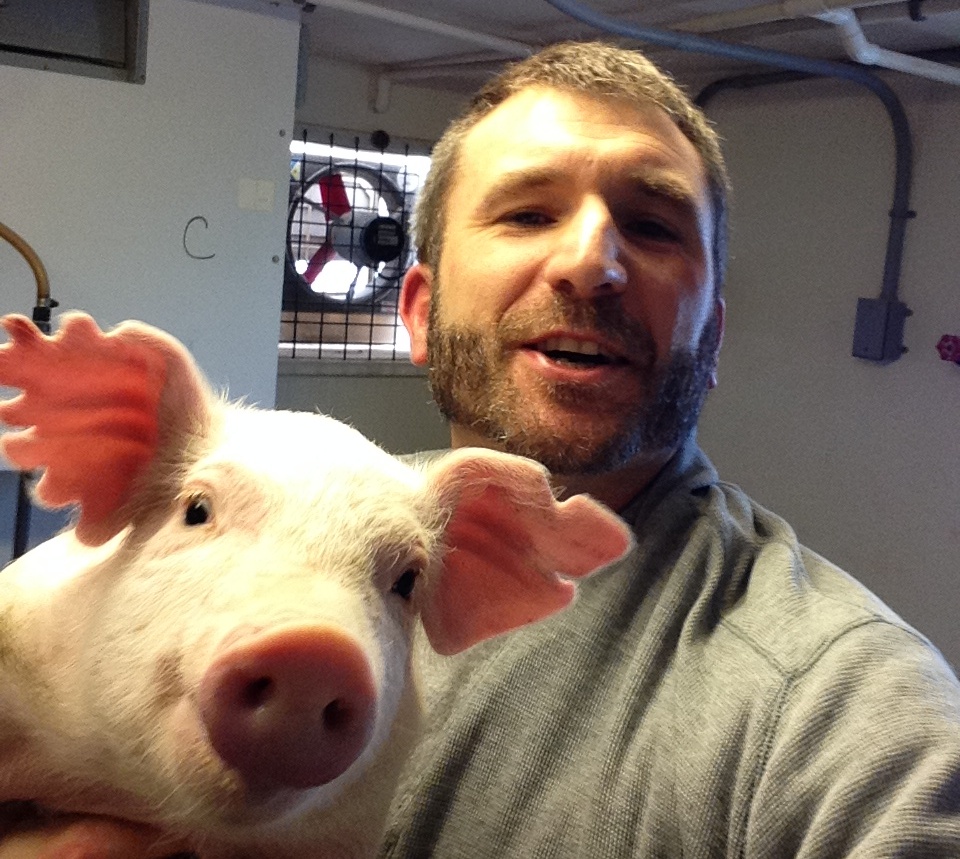
Only a few times are you not bored, and they are frightening and painful events. These events are medical procedures that occur in your first three days of life. Being a female, you need not worry about castration, but your brothers do, and they will have their testes cut off with no anaesthetic, but perhaps a shot of antibiotics to prevent infection. The farmer needs to assign you an identification number, and she will do so by cutting notches in your ear in a way that spells out a string of letters. Piglets have a particularly pressing need for iron, so it is given to them in the form or a shot. Finally, your tail is docked. It hurts, but is less painful than having other pigs bite your tail in the finishing stage of production (discussed previously). Most hog producers used to cut the needle teeth of piglets, so that they can’t injure their mother’s teat while nursing or their siblings when playing. It is my understanding that this practice is increasingly rare.
Figure —Dr. Norwood’s selfie with a pig (notice the notches in its ear, used as an identification)
The nursery stage
You were not ready to be weaned at three weeks. Under natural conditions you would have been much older, but the sooner you are weaned the sooner your mother can be bred again and give birth to another litter. Quickly, you are moved to a building they call the nursery, and are placed in a pen with your siblings and other pigs of a similar age. The building smells different than the farrowing crate. That is because it was completely depopulated of hogs before your arrived ad sanitized thoroughly. Likewise, right after you leave it will be cleaned and sanitized before a new group enters, which is why they refer to such as system as an “all-in, all-out” system. Being at a young age, and under the stress of an early weaning, your immune system is vulnerable, yet because of the care taken by the farmer to sanitize the building, and because of the antibiotics in your feed, you are unlikely to experience poor health. The feed must be designed with great care to transition you from mother’s milk to an all-grain diet, but the science of nutrition is nearly perfected. While in the nursery they may go through four different diet formulations. The livestock industry will give more thought into what goes into the feed of piglets than their own stomach, and in some cases, even their children! The feed is tailored to their specific age and weight, but the feed for all the hogs consists mostly of corn and soybean meal with various supplements like minerals, vitamins, and amino acids. Antibiotics are usually added to the hogs’ feed or water from the time they begin eating grain until they are 100 lbs in weight. By not using antibiotics when the hogs reach 100 lbs we ensure no antibiotic residues will be found on pork meat.(I1)
Like every other building containing hogs, the temperature is always kept at a comfortable level regardless of the heat or cold.
Figure dd—

The pen has hard slatted floors and is barren, except for perhaps a chain which you can bite and pull, or maybe a ball. Although you miss your mother’s milk there is unlimited feed, and you love the way it tastes. As with the farrowing crate, your only lacking need is relief from boredom. There is nothing to do in a small barren pen. There is one thing you miss from the farrowing-crate: a soft mat. Here in the nursery there is nothing comfortable to lie on, but that is to ensure that you and your pen-mates have minimal contact with manure.
One shouldn’t underestimate the benefits of keeping hogs on slatted floors. Compared to 70 years ago, when hogs would be kept on the ground or mulch, lungworms used to infect 50% of hogs but today only infect 11%. Most hogs in 1940 had kidney worms, but very few do today. Trichenella, a parasite that can infect humans if they eat undercooked pork, used to scare us into overcooking pork, whereas it is basically a non-issue today.(N1)
Finishing stage
If you were not being reserved for breeding you would be sent to the “finishing floor”, the last stage before you are harvested, but even if you remained on the farm for breeding the next stage of your life would be about the same as the finishing stage. After being in the nursery for six weeks—where you have now reached nine weeks of age and weigh about 60 lbs—you will be sent to the finishing floor, which is actually a building. Led into the barn for the first time and directed to your pen, it will seem nearly identical to the nursery. A hard, slatted floor throughout. A trough with unlimited feed. Hard walls. Perhaps a chain or ball to play with, but nothing more. It differs from the nursery in that it is bigger, and you are with a larger group of hogs.
Figure dd—The finishing floor
Although bored, you are in fine health, for your feed is nutritious, the barn is clean and the low amounts of antibiotics added to your feed help you stay healthy (and grow faster). It is a good thing your tail is docked, or in boredom your pen-mates would always be nibbling your tail out of boredom (and you would be biting the tails of others, for you are bored too).
As you and your pen-mates grow, unless you are sent to bigger pens, you will have less and less space to move around. Just before slaughter your body will take up approximately five square feet of space, but the square feet per pig in your pen is only eight.
Then, for males and the gilts not reserved for breeding (very few males are needed for breeding), comes the day after which there will be no more boredom. At almost half-a-year old and 275 lbs, you will be taken from your home and slaughtered for meat, providing about 150 lbs(O1) of retail pork—enough to feed three typical Americans for a whole year.
First conception and gestation
However, in this hypothetical life you are a female reserved for breeding, at roughly the same age your brothers are slaughtered. Though nearly a fully-grown pig you will still be called a gilt until you give birth, thereby earning the label “sow”. You may be bred to a live boar, but it is more likely you will be artificially inseminated, which is the farmer’s way of making sure your offspring have genes for fast growth and high felicity. Because you are the product of such a boar, you will conceive quickly and give birth to a litter of ten to twelve farrows (baby pigs), and conceive again quickly after your first litter is weaned.
Once you have conceived, you have three months, three weeks, and three days until you give birth, during which you must spend in a gestation-crate. Much of the benefits of the crate go unnoticed. Because you are always in good health, poor health is something you never experience and thus take it for granted. Although you are sometimes uncomfortable because there is only a hard, slatted floor beneath your feet, the slats allow the manure from you and the others to fall into a pit below, preventing the spread of disease through fecal contact. Being in an individual crate the farmer can give you the precise nutrients you need, in the amounts appropriate for your size. When younger you were allowed all the food you could eat, but now that you are bigger, it would compromise your health. Also, because you do not eat in a group with other sows your food is not taken by a dominant sow, you are certain to receive all the nutrients you need, and because you cannot take the food of subordinate pigs, resulting in excessive eating, you are at the perfect weight. Although sores might appear on your skin due to the hard floor, injury from other animals will not happen, no matter how cruel the other sows in the building may be.
Figure dd—Gestation Crate
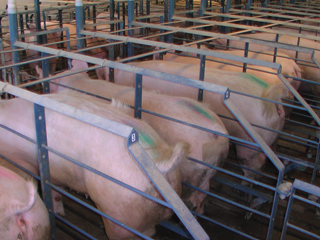
The problem you face in the gestation-crate is the same problem you will encounter throughout your life: boredom and hard floors. The crate is barely larger than your body; you cannot even turn around. A step forward or backward is possible, but that is all. Eventually you learned to pass the time by biting the bars and lifting them up and down, or scratching at the hard floor with your feet, but it provides little relief.
Each day of your gestation adds only a little weight, so you do not really notice the changes your body is experiencing until it is close to birthing-time. Before you go into labor, though, your boredom is temporarily relieved as you are taken from your gestation-crate and moved to a farrowing-crate. Everything seems exactly the same, except there are empty spaces between your crate and the next sow's crate (later you will learn that space is for piglets only, and there is a little more leg room when you lie down.
Your first litter
Like your mother, you give birth to a litter of ten to twelve piglets, and though the labor seemed difficult at first, farm workers soon arrived to help bring your barrows and gilts into the world. You have matured from a gilt into a sow. Although your mobility is just as constrained as you were in the gestation-crate the boredom is not quite as acute because you are feeling new emotions. The feeling of twelve piglets scrambling over each other for a teat was strange at first, but as they helped drain the milk the pressure in your udder was relieved, such that nursing becomes an enjoyable experience. Standing up and lying down is difficult at first, as the small crate makes you do so carefully, slowly. Again, some of the advantages of the farm system are taken for granted because you do not know what life would be on a different farm system. Namely, at least with this litter, you will not feel an odd, moving lump when you lie, and you will not have to learn later that this lump was one of your offspring that you crushed. In this sense you are lucky in that all your piglets are still alive. Even with the crates, about 5% of farrows die from crushing (and another 5% die for other reasons). You take advantage of the greater legroom by resting more, and because you are now eating for 13, you are allowed more feed.
Three weeks pass, and you have become so used to the farrowing-crate that you paid little attention to what is going on around you. Sleeping through the moment the farm workers remove your offspring to take them to the nursery, you awake to find all your farrows (piglets) gone. A little later the workers then move you from the farrowing-crate and back to the gestation-crate. Four days after weaning you are artificially inseminated again, and after another 3 months, 3 weeks, and 3 days, you will return to the farrowing-crate to have a second litter. Then you have a third litter, and then a fourth. For some reason you do not conceive immediately after the fourth litter, and so the farmer decides it would be more efficient to replace you, an increasingly unproductive sow, with one of your offspring, whose youth allows a quick conception.
Just because you are no longer productive at the farm doesn't mean you do not have value to humans though, as you are finally sold to a slaughtering plant where you meat will be made into ground pork.

